Full Description
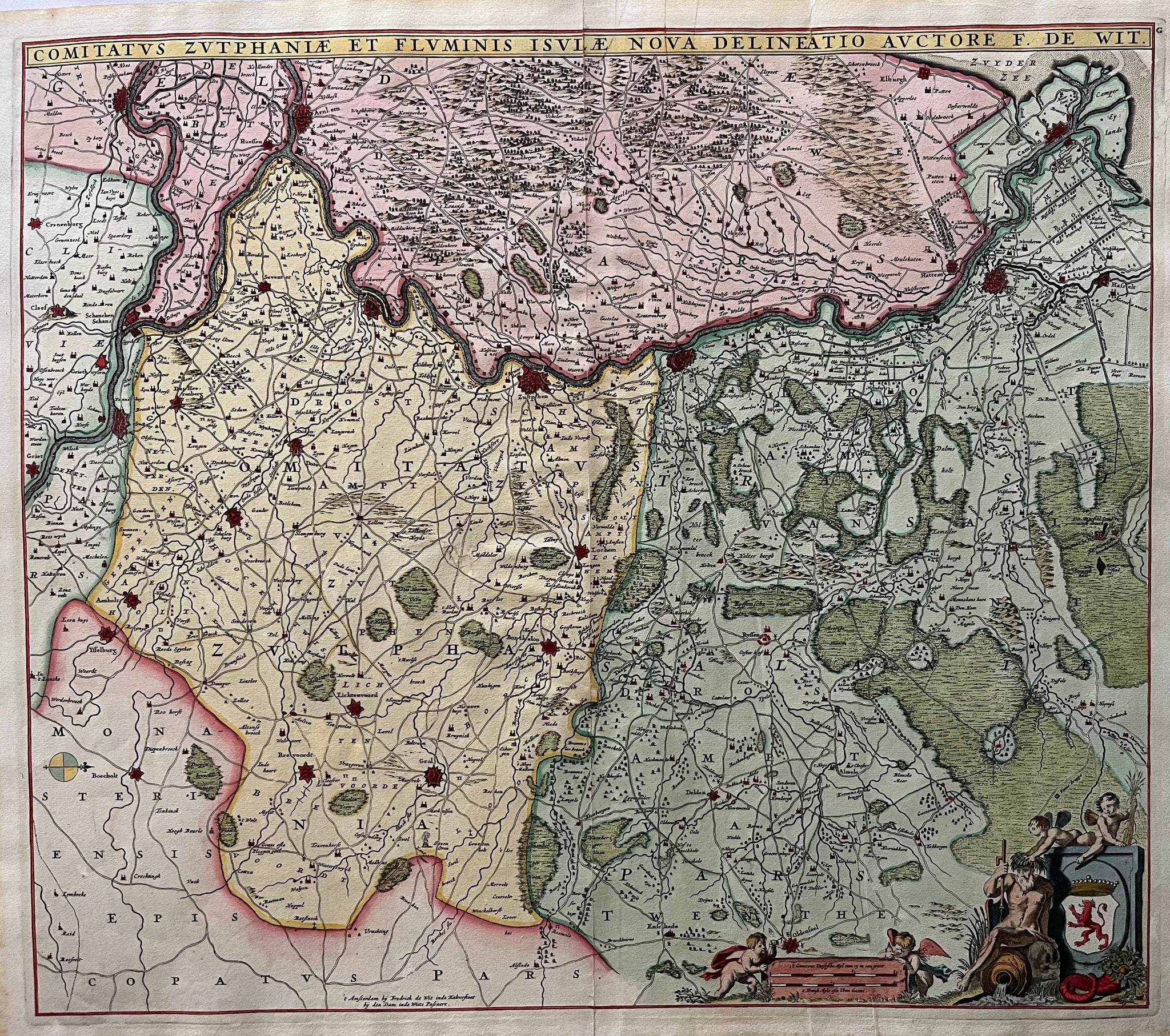
This Gelderland Antique Map titled ‘Comitatus Zutphaniae Et Fluminis Isulae Nova Delineatio Auctore F. De Wit’ is a fine 17th‑century engraving by Frederick de Wit. Published in Amsterdam around 1680, the map shows the province of Gelderland and the course of the IJssel River with towns such as Zutphen, Deventer, Zwolle, and Grol.
The map measures 48.5 x 56 cm and is handcoloured. Strong lines and rich tones highlight rivers, borders, and settlements of the Achterhoek region. De Wit’s clear engraving style makes the geography both accurate and decorative.
The map remains in very good condition and offers historical and artistic appeal. This Gelderland Antique Map De Wit is ideal for collectors of Dutch cartography and lovers of 17th‑century mapping. It combines precision, colour, and classic design from one of Holland’s best‑known mapmakers.
About the Artist: Frederik de Wit
Frederik de Wit (c. 1629 – July 1706) was a prominent Dutch cartographer, engraver, and map publisher active during the Dutch Golden Age. Born in Gouda, he moved to Amsterdam around 1648 and established his own printing business by 1654, initially named “De Drie Crabben” and later “De Witte Pascaert.”
De Wit is known for his detailed and artistically decorated maps, including sea charts, town plans, and wall maps. His publications include atlases like the “Atlas Maior” and the “Nieuw Kaertboeck van de XVII Nederlandse Provinciën,” which featured numerous maps of the Netherlands and other regions. De Wit acquired many printing plates from the Blaeu firm, expanding his catalog and influence. His work is celebrated for combining geographical accuracy with elaborate cartouches and decorative elements, making his maps valued by collectors and historians. After his death, his plates were auctioned and passed to notable publishers such as Pieter Mortier, influencing cartography well into the 18th century.
About the Era: 17th Century (1600s)
The 17th century greatly advanced mapmaking and printmaking, with copperplate engraving enabling cartographers to create detailed and accurate maps. During the Dutch Golden Age, increased trade and exploration boosted the demand for maps, turning map printing into a major industry. Skilled engravers carved designs into copper plates, applied ink, and pressed paper to produce fine prints. After printing, artisans hand-colored maps to enhance their beauty and clarity. Copperplate printing replaced woodcuts, offering smoother lines and finer details. Renowned mapmakers like Blaeu, Janssonius, and Hondius combined scientific knowledge with artistic skill. This era produced remarkable atlases, such as Joan Blaeu’s Atlas Maior. Maps not only charted geography but reflected political power, trade routes, and scientific discoveries. Printed maps became essential for navigation, colonization, and education. Dutch publishers led Europe’s map market, shaping global cartographic standards. These original maps remain prized for their detail and artistry, influencing future mapmaking and holding high value for collectors and museums today.