Full Description
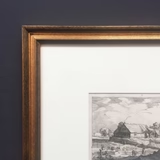
Prospectus Castelli Boxtel is a finely detailed engraving by Gaspar Bouttats, after J. van Croes. It was published in 1690 in Groot Wereldlyk Tooneel des Hertogdoms van Braband. The print shows a clear view of the castle at Boxtel in the Dutch province of Brabant. Trees and landscape elements surround the castle and enhance its stately character. Bouttats’ engraving style gives the scene balance and elegance.
This antique engraving of Boxtel measures 11.5 × 21 cm and is in very good condition. The strong impression shows crisp lines and clear tonal contrast. Collectors value this antique engraving of Boxtel for its fine craftsmanship, historical importance, and elegant view of Brabant’s architectural heritage. VAT: Margin goods, no VAT charged.
Explore our entire collection of City Views, antique maps, Botanical prints and much more at our store located in the historic heart of Haarlem.
About the Artist: Caspar Boutats
Caspar Boutats, also known as Gaspar Bouttats the Elder (circa 1640 – 1696), was a Flemish printmaker and engraver from Antwerp. Born into a family of engravers, he was the son of Frederik Bouttats the Elder and received training from his father. He was active during the Baroque period and became a prominent figure in the Antwerp Guild of Saint Luke, serving as its dean in 1690–1691. Boutats is known for his etchings and engravings mainly created for booksellers, including historical, topographical, and portrait works. Notably, he engraved scenes such as “The Massacre of St. Bartholomew” and “The Assassination of Henry IV,” and produced city views for important folio volumes. His work is valued for its artistic quality and historical significance, reflecting Baroque Flemish engraving traditions.
About the Era: 17th Century (1600s)
The 17th century greatly advanced mapmaking and printmaking, with copperplate engraving enabling cartographers to create detailed and accurate maps. During the Dutch Golden Age, increased trade and exploration boosted the demand for maps, turning map printing into a major industry. Skilled engravers carved designs into copper plates, applied ink, and pressed paper to produce fine prints. After printing, artisans hand-colored maps to enhance their beauty and clarity. Copperplate printing replaced woodcuts, offering smoother lines and finer details. Renowned mapmakers like Blaeu, Janssonius, and Hondius combined scientific knowledge with artistic skill. This era produced remarkable atlases, such as Joan Blaeu’s Atlas Maior. Maps not only charted geography but reflected political power, trade routes, and scientific discoveries. Printed maps became essential for navigation, colonization, and education. Dutch publishers led Europe’s map market, shaping global cartographic standards. These original maps remain prized for their detail and artistry, influencing future mapmaking and holding high value for collectors and museums today.