Full Description
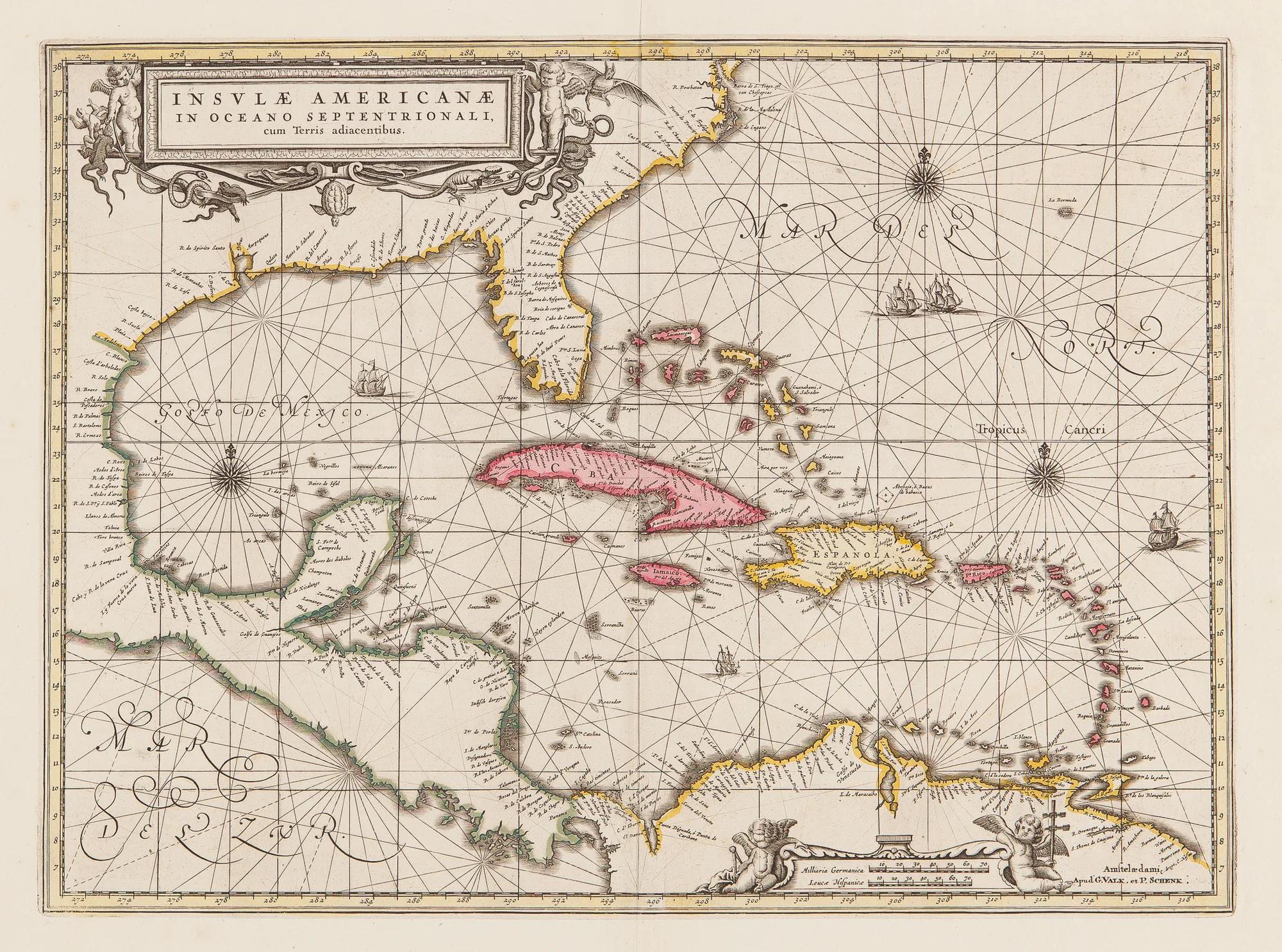
This rare antique map of the Americas is titled “Insulae Americanae in Oceano Septentrionali cum Terris adiacentibus.” It shows the islands of the Americas in the North Atlantic, together with surrounding coastal regions. The map presents the Caribbean, parts of North America, and the northern coast of South America in clear detail.
Peter Schenk and Gerard Valk published this map around 1690. They based it on the rare chart by Hessel Gerritsz from 1631. The geography closely follows Gerritsz’s original work, with the addition of the west coast of Central America. This rare antique map of the Americas reflects Gerritsz’s firsthand knowledge from his voyage to South America and the West Indies in 1628. Contemporary hand colouring adds clarity and visual appeal.
The map measures 38 × 53 cm and is in very good condition. It has wide margins and a clean, crisp impression. The verso is blank. Small holes appear along the coast of the Gulf of Mexico near Quitazenho and Boca de Conil, caused by green ink. Collectors value this antique map of the Americas for its rarity, early sources, and strong historical importance.
VAT: Margin goods, no VAT charged.
About the Artist: Gerard Valk, Peter Schenk
Gerard Valk (1652–1726) was a Dutch engraver, publisher, and cartographer active in Amsterdam. He trained under Abraham Blooteling and worked with Peter Schenk to produce detailed maps, globes, and atlases during the Dutch Golden Age. Valk specialized in precise regional maps of Europe and created innovative celestial globes. Collectors prize his works for their artistry and cartographic accuracy.
About the Era: 17th Century (1600s)
The 17th century greatly advanced mapmaking and printmaking, with copperplate engraving enabling cartographers to create detailed and accurate maps. During the Dutch Golden Age, increased trade and exploration boosted the demand for maps, turning map printing into a major industry. Skilled engravers carved designs into copper plates, applied ink, and pressed paper to produce fine prints. After printing, artisans hand-colored maps to enhance their beauty and clarity. Copperplate printing replaced woodcuts, offering smoother lines and finer details. Renowned mapmakers like Blaeu, Janssonius, and Hondius combined scientific knowledge with artistic skill. This era produced remarkable atlases, such as Joan Blaeu’s Atlas Maior. Maps not only charted geography but reflected political power, trade routes, and scientific discoveries. Printed maps became essential for navigation, colonization, and education. Dutch publishers led Europe’s map market, shaping global cartographic standards. These original maps remain prized for their detail and artistry, influencing future mapmaking and holding high value for collectors and museums today.