Full Description
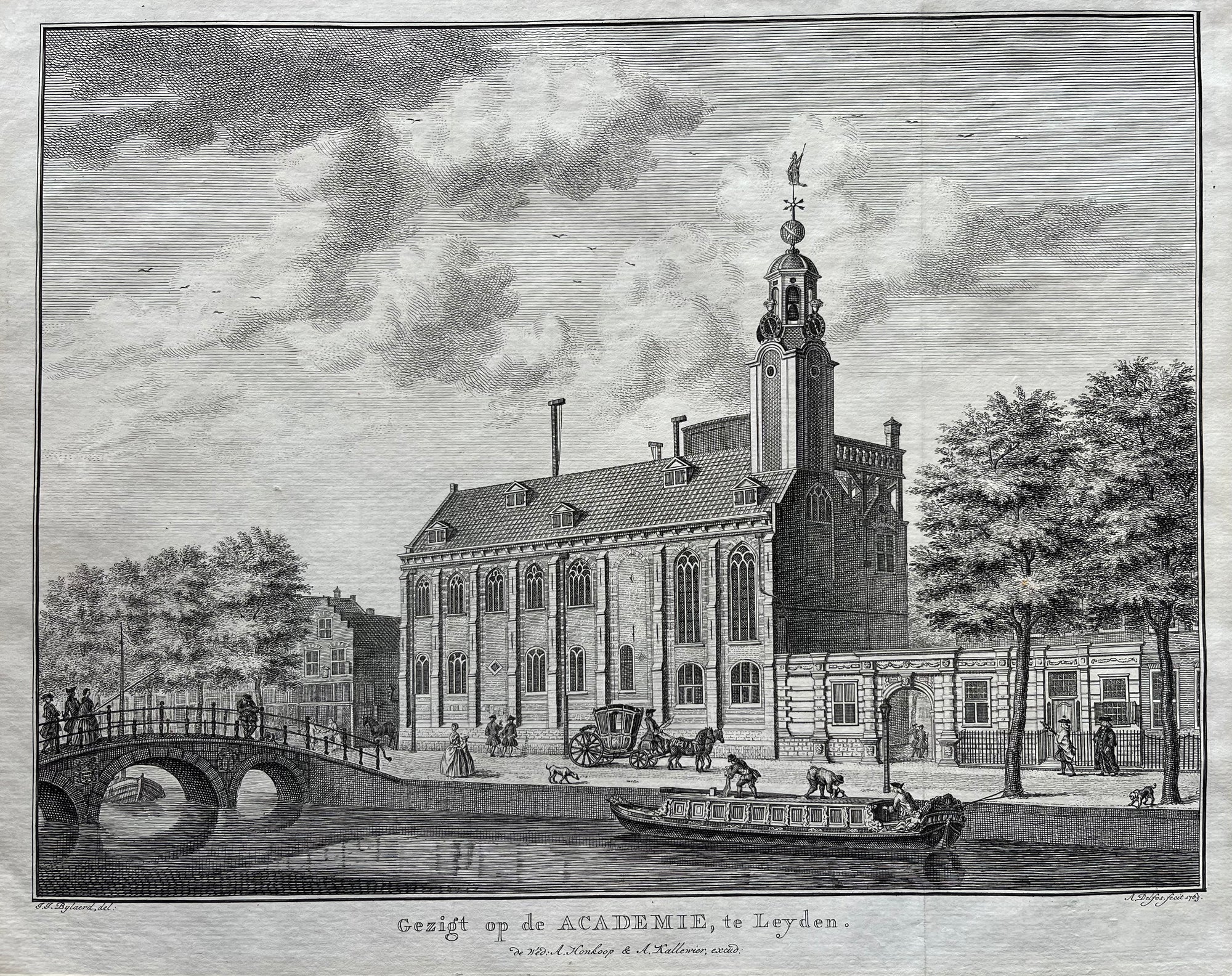
This beautiful antique 1763 Leiden Academie engraving, titled Gezigt op de ACADEMIE, te Leyden, shows a detailed view of the historic Academie building on Rapenburg in Leiden. It was created by A. Delfos from a drawing by J. Bylaerd and published in 1763 by Wed. A. Honkoop and A. Kallewier.
The Academie is the oldest building of Leiden University, founded in 1575. Originally a convent church for Dominican nuns, it was converted into the Academy building in 1581. Today, it remains a central location used for university ceremonies like graduations and inaugural lectures.
The engraving captures the elegance of the 18th-century architecture along the picturesque Rapenburg canal, which has long been associated with Leiden University’s rich academic history. The print also reflects the city’s cultural importance during the Dutch Golden Age.
Collecting antique city views of Leiden or historical academic buildings? This engraving, preserved in very good condition with its original fold, represents a charming and significant piece of Leiden’s heritage.
Explore our full selection of rare Dutch prints and maps at our store, located in the heart of Haarlem.
About the Artist: Abraham Delfos
Abraham Delfos (1731–1820) was a Dutch artist, art dealer, and auctioneer based in Leiden. He trained under Jan Wandelaar and became known for his graphic work and drawings after old masters. Delfos created several commissioned prints and book illustrations, including a notable series of twelve prints depicting the sled parade of January 24, 1776, organized by the Leiden society Veniam Pro Laude. He also reproduced old artworks, contributing to the preservation of Dutch artistic heritage. Aside from his artistic work, Delfos was very active in Leiden’s auction scene, organizing multiple auctions from 1769 to 1808, and often buying frequently at these sales to replenish his stock. He served as director of the Leiden Drawing Academy from 1761 and later as chairman of the art society Ars Aemula Naturae.
About the Era: 18th Century (1700s)
During the 18th century, mapmaking became more scientific and precise. Improved instruments like the telescope and chronometer helped cartographers increase accuracy, shifting maps from decorative art to factual documents. Copperplate engraving stayed as the main printing method, producing fine lines, while hand-coloring added visual impact. French cartographers, such as the Cassini family, led national surveys with geodetic measurements and triangulation, while Dutch mapmakers like Joan Blaeu enhanced printing and atlas quality, ushering in a golden age of atlases.
Maps began including more information and notes to help users, and ornate decorations mostly gave way to scientific clarity, except for cartouches and borders. National and colonial ambitions guided map production to aid navigation and territorial claims. By the late 18th century, large-scale surveys set modern cartography standards. Today, 18th-century maps mix scientific knowledge with artistry, are prized by collectors, and have influenced later cartographic methods. They offer insights into Enlightenment exploration and geography.