100% ORIGINAL ANTIQUE PRINTS & MAPS FREE SHIPPING OVER €100 (NL) SECURE CHECKOUT 100% ORIGINAL ANTIQUE PRINTS & MAPS FREE SHIPPING OVER €100 (NL) SECURE CHECKOUT

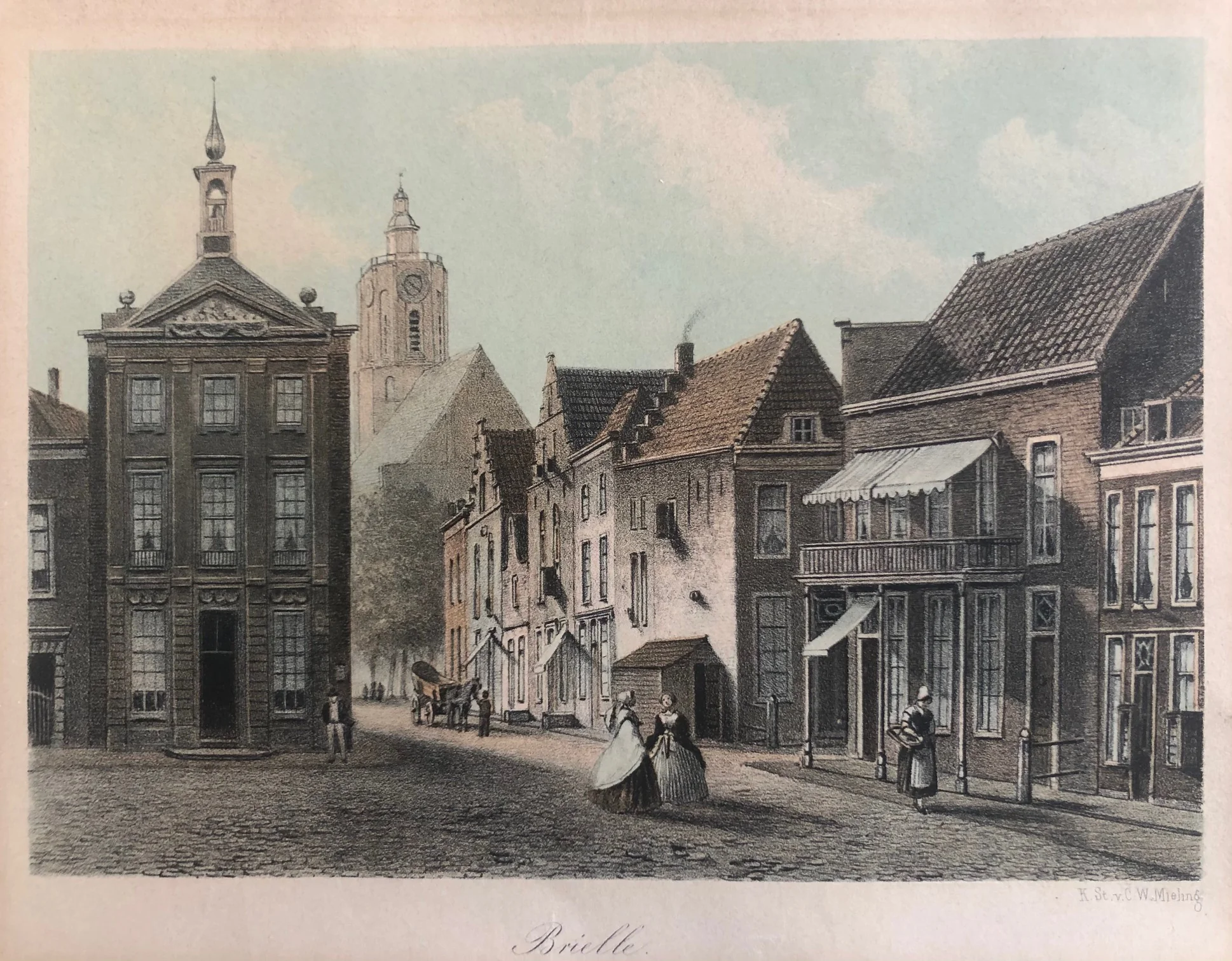
Brielle

Lithograph by Unknown, 1860

125.00

This authentic antique print, measuring 22.5 cm × 16 cm , created by Unknown as a fine example of Lithograph work from the 19th Century (1800s).

Published by C.W. Mieling, it is preserved in Good condition and displays remarkable period craftsmanship.

Out of stock

Full Description

This Brielle City View Lithograph offers a peaceful 19th‑century scene of the historic town in South Holland. Published by C.W. Mieling around 1860, it shows Brielle with fine architectural detail and warm tinted tones. The composition captures the quiet charm of the town’s canals, buildings, and surrounding countryside.

The lithograph measures 16 x 22.5 cm and is in good condition. Its soft colouring and balanced design make it a pleasing and decorative piece. The fine lines and gentle shading reflect Mieling’s craftsmanship and the artistic style of the period.

This Brielle City View Lithograph will appeal to collectors of Dutch prints and admirers of Holland’s historic towns. It combines artistic simplicity with local character, making it a lovely addition to any collection of antique views.

About the Artist: Unknown

Unfortunately, there is no information available about this artist yet. We will update this section when possible.

About the Era: 19th Century (1800s)

The 19th century marked the era of cartography, as mapmaking became professional, organized, and global. Scientists and surveyors used improved instruments and statistical methods, turning maps into trusted scientific documents with greater precision. Surveying advanced with triangulation, precise tools, and national topographic programs. Printing technology improved, adopting lithography and early color printing to produce clearer, richer maps. New thematic maps used techniques like choropleth, flow lines, and dot density to show data visually. Notably, Charles Minard pioneered multivariate mapping, combining multiple data themes on one map.
Map design reflected industrial and Victorian tastes, balancing detail and readability. Governments supported mapping societies to control territories at home and abroad. Maps became essential for urban planning, empire-building, and scientific research. The 19th century also fostered a global map culture, sharing knowledge internationally. Today, 19th-century maps are prized for their science and artistry. They laid the foundation for modern cartography, data visualization, and geographic information science, and are celebrated by collectors and institutions for their insight into industrial-age geography and culture.


Additional information

Dimensions 22.5 × 16 cm
Artist

Condition

Era

Frame

No Frame

Orientation

Technique

Lithograph

Published by

C.W. Mieling

Publish Date

1860

Shipping & Delivery

Our antique prints are carefully packaged to ensure safe arrival.
Smaller prints are shipped in acid-free, flat protective packaging, while larger works are securely rolled and sent in a sturdy tube to preserve their condition.

Shipping Rates

Netherlands: €7.50 — 

European Union: €15

Outside the EU: On request (contact us for an exact quote)

Framing Options

We offer custom framing for all prints, from classic antique frames to contemporary minimalist styles.

How Framing Works

Choose any print from the collection

We discuss frame styles, materials & pricing

The print will be professionally framed and shipped via courier for maximum safety

If you would like your print framed, please contact us, we are happy to advise on styles and options.

DeVries DeVries compact Black Frame
DeVries DeVries compact Black and gold/bronce Frame
DeVries DeVries Black and brown Frame

Contact Us

For any special arrangements, you can contact us directly or use the form below.

Condition of this piece: Good

Very Fine

Our highest classification. These prints are clean, bright, and exceptionally well-preserved, featuring a strong and crisp image. No notable imperfections.

Fine

Prints in this condition show a clean, sharp image. Paper quality or margin size may vary slightly. Minor age-related characteristics, such as small wormholes, light toning, or tiny separations may be present depending on the print date.

Very Good

No major imperfections. Any minor flaws or historical repairs are fully noted in the product description. Overall a well-preserved and collectible piece.

Good

These prints show noticeable imperfections such as foxing, weaker image strength, or longer separations, but remain collectible. All visible characteristics are clearly described.

You might also like