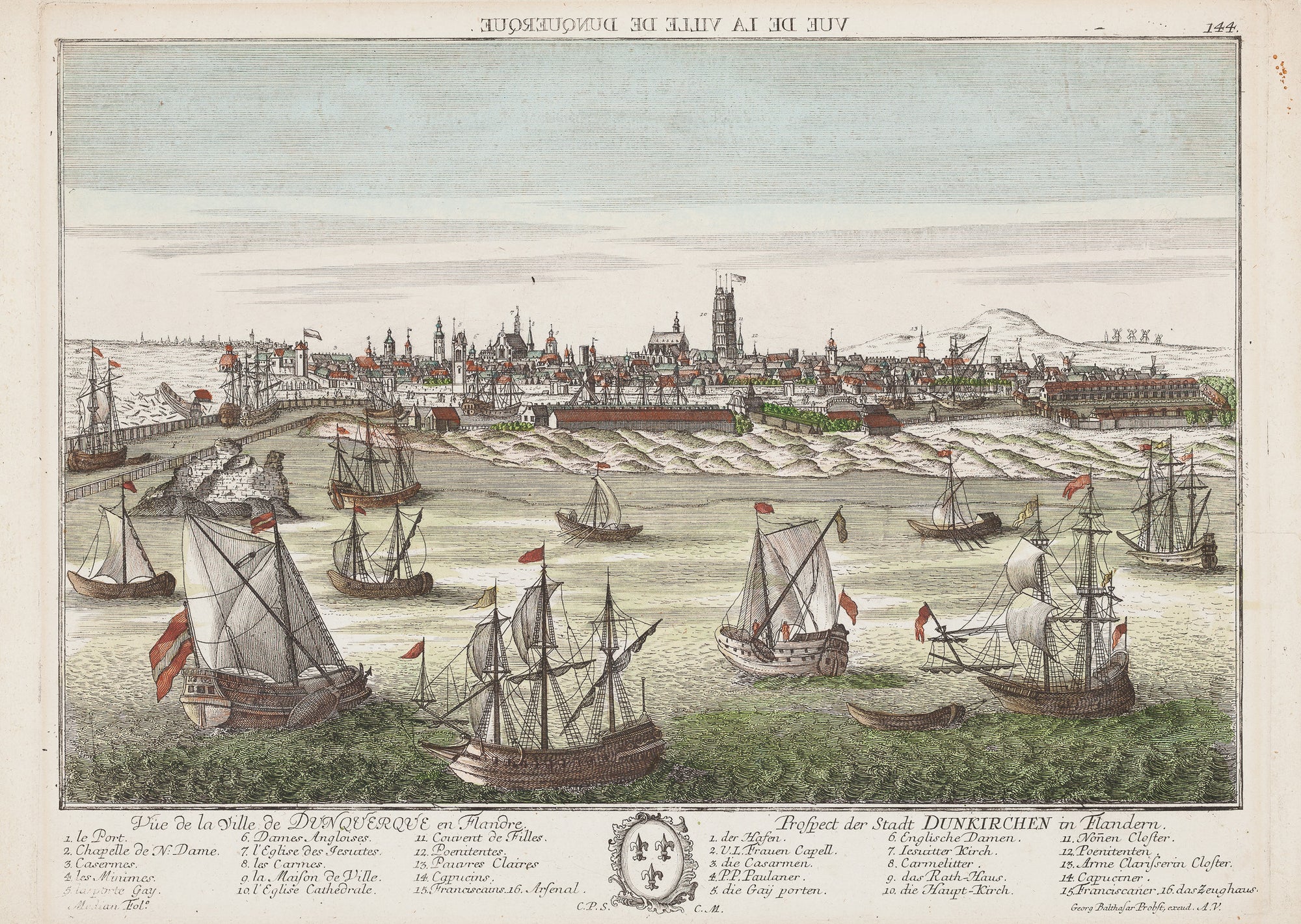
Hand-colored copper engraving by Georg Balthasar Probst, circa 1760
€225.00
This authentic antique print, measuring 41.5 cm × 27 cm , created by Georg Balthasar Probst as a fine example of Hand-colored copper engraving work from the 18th Century (1700s).
Published by Georg Balthasar Probst, it is preserved in Good condition and displays remarkable period craftsmanship.
1 in stock
This vintage Dunkirk engraving shows the city of Dunkirk in Flanders. It features French and German titles: ‘Vue de la Ville de Dunquerque en Flandre – Prospect der Stadt Dunkirchen in Flandern.’ Probst published this hand-colored copper engraving in Augsburg around 1760. The optical print measures 27 by 41.5 cm. It creates a 3D effect for peep boxes. The condition is good. Collectors love these Augsburg views for their perspective and color. Dunkirk was a key port in 18th-century Flanders. Own this vintage Dunkirk engraving for historic French coastal art.
Discover our entire collection of antique maps and prints at our store located in the historic heart of Haarlem.
Georg Balthasar Probst (1732–1801) was a German engraver and publisher from Augsburg. He created detailed city views and large panoramic prints. Probst made optical engravings designed for special viewing devices. His work shows precise perspective and fine detail. Collectors value his prints for their artistic quality and historical importance. Probst belonged to a family of printers linked to the Jeremias Wolff publishing house. He played a key role in Augsburg’s printmaking tradition.
During the 18th century, mapmaking became more scientific and precise. Improved instruments like the telescope and chronometer helped cartographers increase accuracy, shifting maps from decorative art to factual documents. Copperplate engraving stayed as the main printing method, producing fine lines, while hand-coloring added visual impact. French cartographers, such as the Cassini family, led national surveys with geodetic measurements and triangulation, while Dutch mapmakers like Joan Blaeu enhanced printing and atlas quality, ushering in a golden age of atlases.
Maps began including more information and notes to help users, and ornate decorations mostly gave way to scientific clarity, except for cartouches and borders. National and colonial ambitions guided map production to aid navigation and territorial claims. By the late 18th century, large-scale surveys set modern cartography standards. Today, 18th-century maps mix scientific knowledge with artistry, are prized by collectors, and have influenced later cartographic methods. They offer insights into Enlightenment exploration and geography.
| Dimensions | 41.5 × 27 cm |
|---|---|
| Condition | |
| Orientation | |
| Publish Date | circa 1760 |
| Technique | Hand-colored copper engraving |
| Published by | Georg Balthasar Probst |
| Frame | No Frame |
| Artist | |
| Era |
Our antique prints are carefully packaged to ensure safe arrival.
Smaller prints are shipped in acid-free, flat protective packaging, while larger works are securely rolled and sent in a sturdy tube to preserve their condition.
Netherlands: €7.50 —
European Union: €15
Outside the EU: On request (contact us for an exact quote)
We offer custom framing for all prints, from classic antique frames to contemporary minimalist styles.
Choose any print from the collection
We discuss frame styles, materials & pricing
The print will be professionally framed and shipped via courier for maximum safety
If you would like your print framed, please contact us, we are happy to advise on styles and options.
Our highest classification. These prints are clean, bright, and exceptionally well-preserved, featuring a strong and crisp image. No notable imperfections.
Prints in this condition show a clean, sharp image. Paper quality or margin size may vary slightly. Minor age-related characteristics, such as small wormholes, light toning, or tiny separations may be present depending on the print date.
No major imperfections. Any minor flaws or historical repairs are fully noted in the product description. Overall a well-preserved and collectible piece.
These prints show noticeable imperfections such as foxing, weaker image strength, or longer separations, but remain collectible. All visible characteristics are clearly described.