Full Description
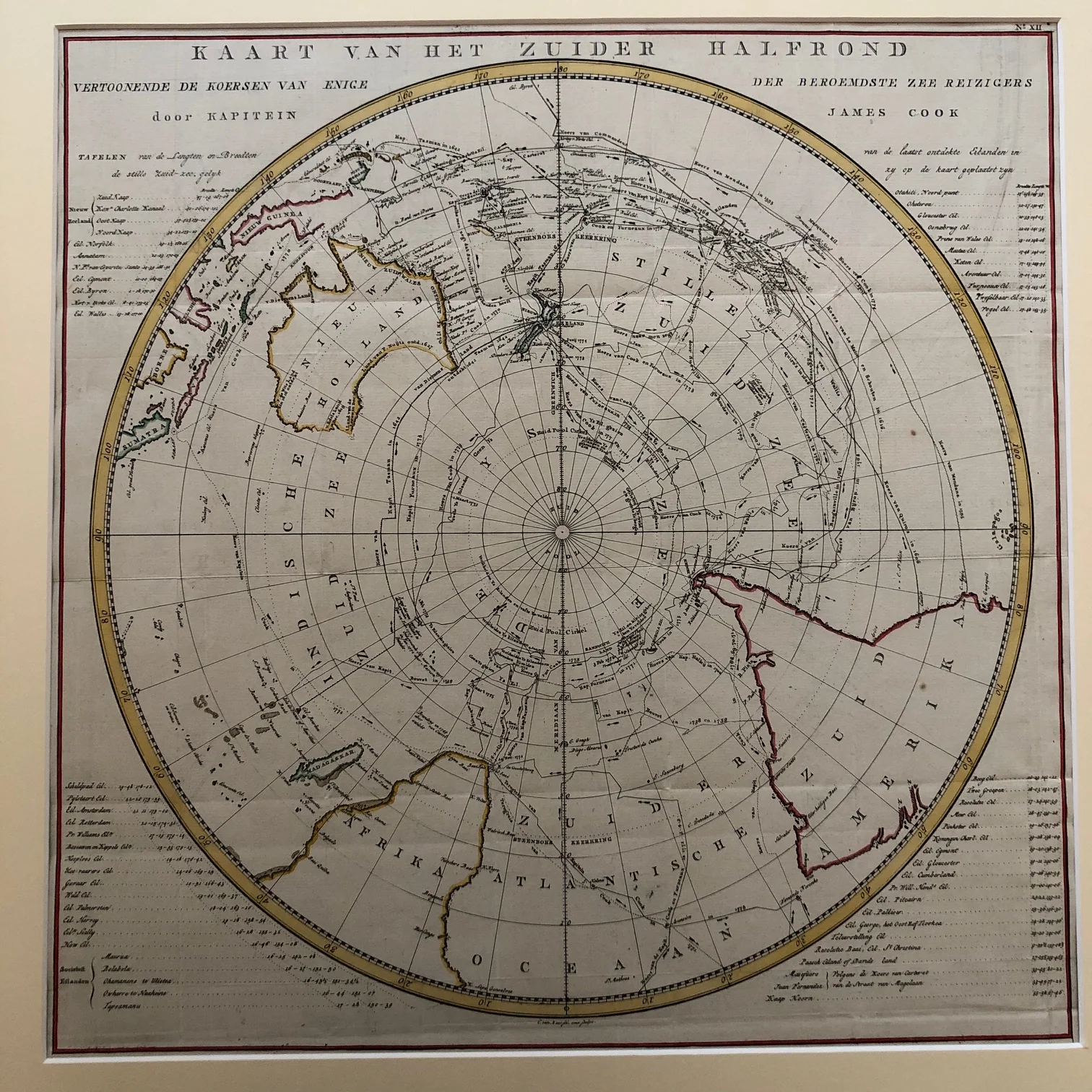
This Southern Hemisphere Map Cook titled ‘Kaart van het Zuider Halfrond, vertoonende de Koersen van enige der beroemdste zee reizigers door Kapitein James Cook’ shows the world below the equator in striking detail. C. van Baarsel engraved and published this map in 1799. It traces Captain James Cook’s famous exploration routes across the Southern Ocean while revealing Antarctica, Australia, New Zealand, southern Africa, and the tip of South America.
The handcoloured engraving measures 53 x 53 cm and comes framed in a black wooden frame with matting. Light folds appear as originally issued, yet the print remains bright and clean. The clear three‑line title at the top and the explanatory texts in each corner enhance its educational and decorative appeal.
This Southern Hemisphere Map Cook is a wonderful piece for map collectors and admirers of exploration history. It celebrates the age of discovery through fine engraving and vivid 18th‑century craftsmanship.
About the Artist: Cornelis van Baarsel
Cornelis van Baarsel (1761–1826) was a Dutch engraver and cartographer known for his detailed maps and scenic engravings. He worked primarily in Amsterdam, producing precise maps of Dutch and overseas territories. Van Baarsel’s work often included botanical illustrations, and he collaborated with his son Willem Cornelis van Baarsel. His engravings are prized for their craftsmanship and historical value, reflecting Dutch cartographic and artistic traditions of the late 18th and early 19th centuries.
About the Era: 18th Century (1700s)
During the 18th century, mapmaking became more scientific and precise. Improved instruments like the telescope and chronometer helped cartographers increase accuracy, shifting maps from decorative art to factual documents. Copperplate engraving stayed as the main printing method, producing fine lines, while hand-coloring added visual impact. French cartographers, such as the Cassini family, led national surveys with geodetic measurements and triangulation, while Dutch mapmakers like Joan Blaeu enhanced printing and atlas quality, ushering in a golden age of atlases.
Maps began including more information and notes to help users, and ornate decorations mostly gave way to scientific clarity, except for cartouches and borders. National and colonial ambitions guided map production to aid navigation and territorial claims. By the late 18th century, large-scale surveys set modern cartography standards. Today, 18th-century maps mix scientific knowledge with artistry, are prized by collectors, and have influenced later cartographic methods. They offer insights into Enlightenment exploration and geography.