Full Description
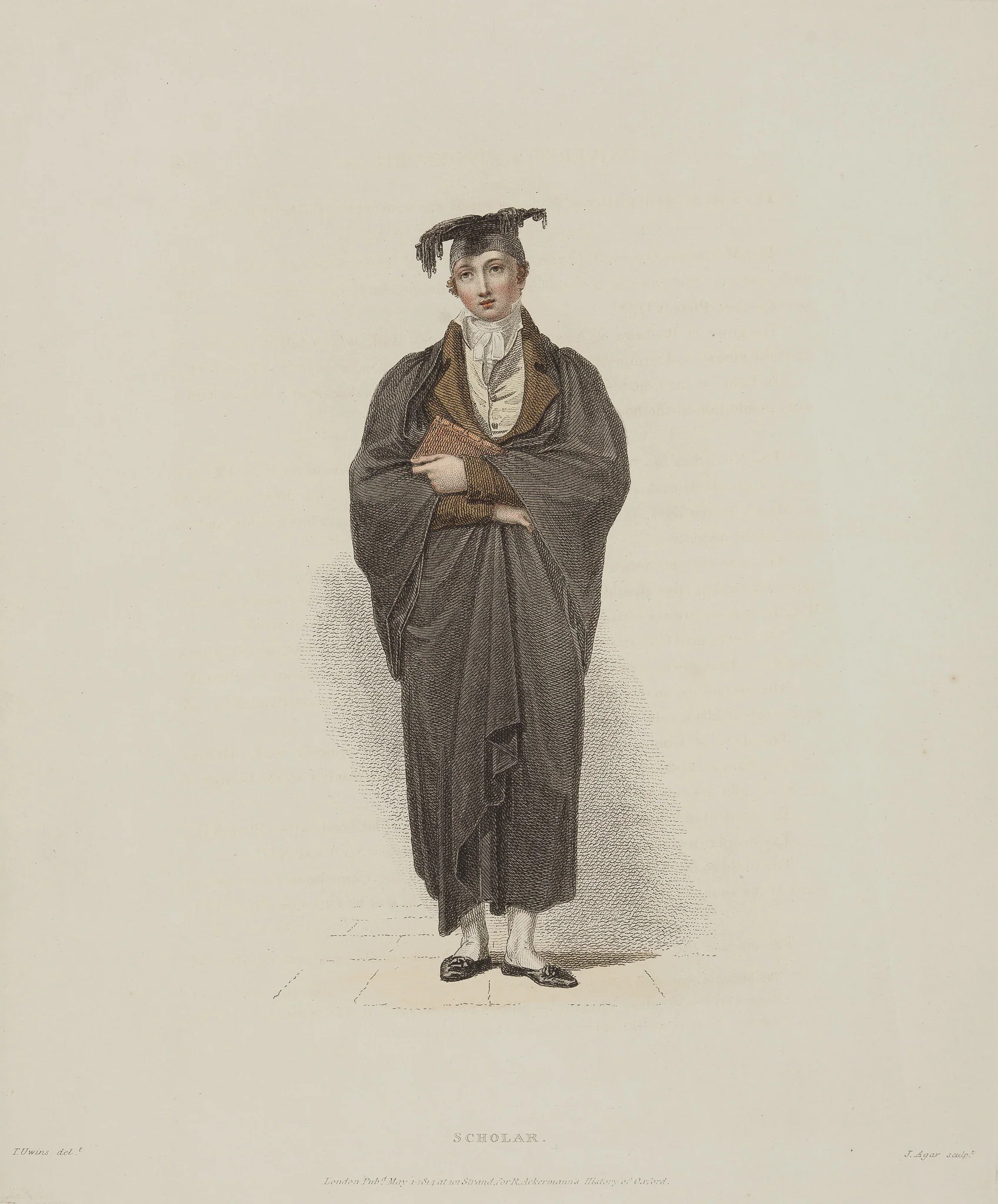
This vintage Oxford engraving titled ‘Scholar’ was created by John Samuel Agar after a drawing by Thomas Uwins. Published in 1814 in R. Ackermann’s renowned ‘History of Oxford,’ the hand-colored print measures 30 by 25 cm. It depicts an academic figure reflecting Oxford’s rich scholarly heritage.
The engraving showcases fine detail and vibrant coloring, capturing the spirit of early 19th-century academic life. The condition is very good, making it ideal for collectors and lovers of historic university art. This piece is a valued part of Ackermann’s illustrated works, representing the intellectual tradition and artistic craftsmanship of the period. Owning this vintage Oxford engraving adds cultural and educational value to any collection, offering a glimpse into the world of one of England’s oldest universities.
About the Artist: John Samuel Agar
John Samuel Agar (1773–1858) was an English portrait painter and engraver. He exhibited his work at the Royal Academy between 1796 and 1806. Agar became known for his detailed engravings and paintings of notable figures in British society. His works often included delicate stipple engraving techniques. Collectors value Agar’s art for its fine craftsmanship and historical significance during the late 18th and early 19th centuries.
About the Era: 19th Century (1800s)
The 19th century marked the era of cartography, as mapmaking became professional, organized, and global. Scientists and surveyors used improved instruments and statistical methods, turning maps into trusted scientific documents with greater precision. Surveying advanced with triangulation, precise tools, and national topographic programs. Printing technology improved, adopting lithography and early color printing to produce clearer, richer maps. New thematic maps used techniques like choropleth, flow lines, and dot density to show data visually. Notably, Charles Minard pioneered multivariate mapping, combining multiple data themes on one map.
Map design reflected industrial and Victorian tastes, balancing detail and readability. Governments supported mapping societies to control territories at home and abroad. Maps became essential for urban planning, empire-building, and scientific research. The 19th century also fostered a global map culture, sharing knowledge internationally. Today, 19th-century maps are prized for their science and artistry. They laid the foundation for modern cartography, data visualization, and geographic information science, and are celebrated by collectors and institutions for their insight into industrial-age geography and culture.