Full Description
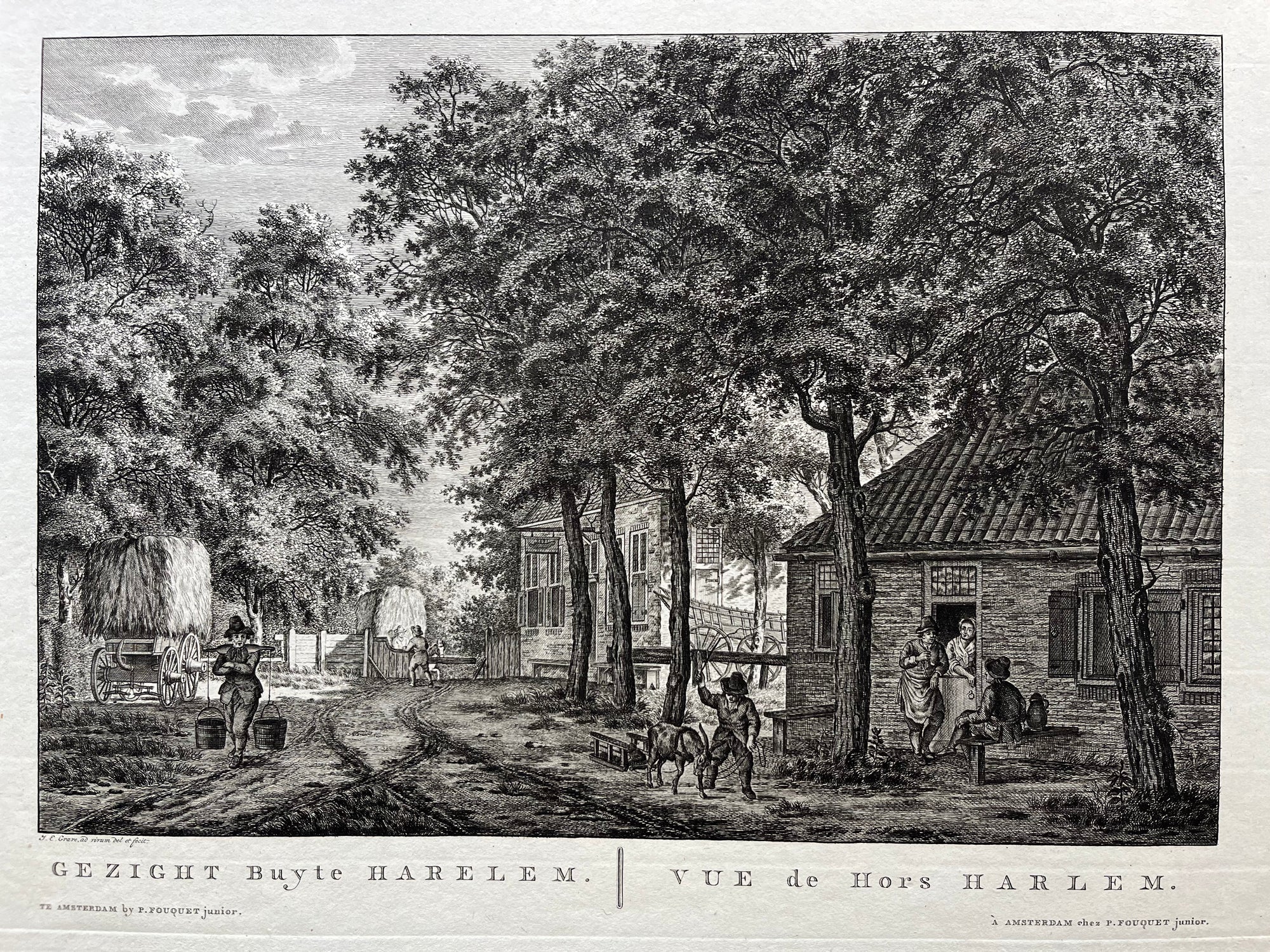
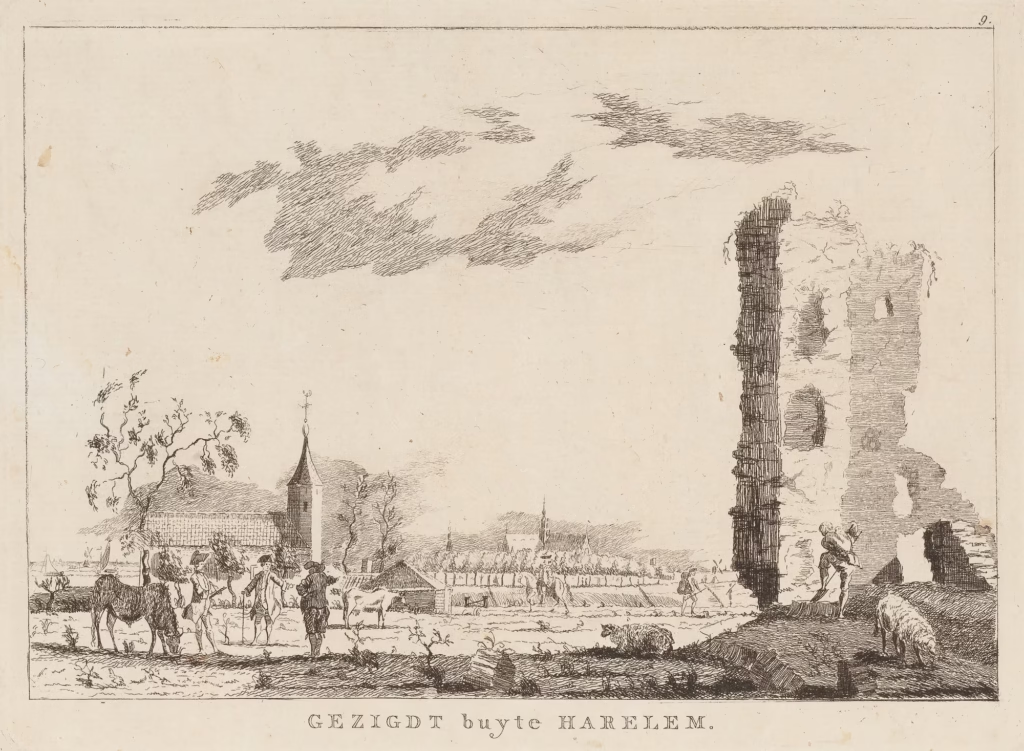
This rare engraving Haarlem Aerdenhout offers a beautifully detailed glimpse into early 19th-century Dutch history. Created by the renowned artist Jan Evert Grave and published by Pieter Fouquet Jr., this print captures the historic inn Haringbuis and the iconic tollgate at the Viersprong crossing, a notable site in Aerdenhout near Haarlem. The artwork exemplifies elegant linework and a strong impression, making it an outstanding example of Haarlem’s topographical prints.
Collectors value this piece not just for its rarity, but for its connection to local heritage and Dutch landscape art. It serves as an essential addition for enthusiasts of Haarlem history, Dutch engravings, and antique maps.
For those interested in similar historic prints, discover related prints in our Noord Holland region collection.
About the Artist: Jan Evert Grave
Jan Evert Grave (1759–1805) was a Dutch engraver known for his early use of the aquatint technique, a graphic method that allowed for shaded tonal effects resembling watercolor washes. Active primarily in Amsterdam, Grave produced fine landscape engravings and other works that are valued for their technical skill and delicate tonal range. His engravings capture scenes such as castles, natural landscapes, and genre scenes reflecting 18th-century Dutch artistic interests. Grave contributed to advancing printmaking by incorporating new techniques and enriching the visual language of Dutch engravings in his era.
About the Era: 19th Century (1800s)
The 19th century marked the era of cartography, as mapmaking became professional, organized, and global. Scientists and surveyors used improved instruments and statistical methods, turning maps into trusted scientific documents with greater precision. Surveying advanced with triangulation, precise tools, and national topographic programs. Printing technology improved, adopting lithography and early color printing to produce clearer, richer maps. New thematic maps used techniques like choropleth, flow lines, and dot density to show data visually. Notably, Charles Minard pioneered multivariate mapping, combining multiple data themes on one map.
Map design reflected industrial and Victorian tastes, balancing detail and readability. Governments supported mapping societies to control territories at home and abroad. Maps became essential for urban planning, empire-building, and scientific research. The 19th century also fostered a global map culture, sharing knowledge internationally. Today, 19th-century maps are prized for their science and artistry. They laid the foundation for modern cartography, data visualization, and geographic information science, and are celebrated by collectors and institutions for their insight into industrial-age geography and culture.