Full Description
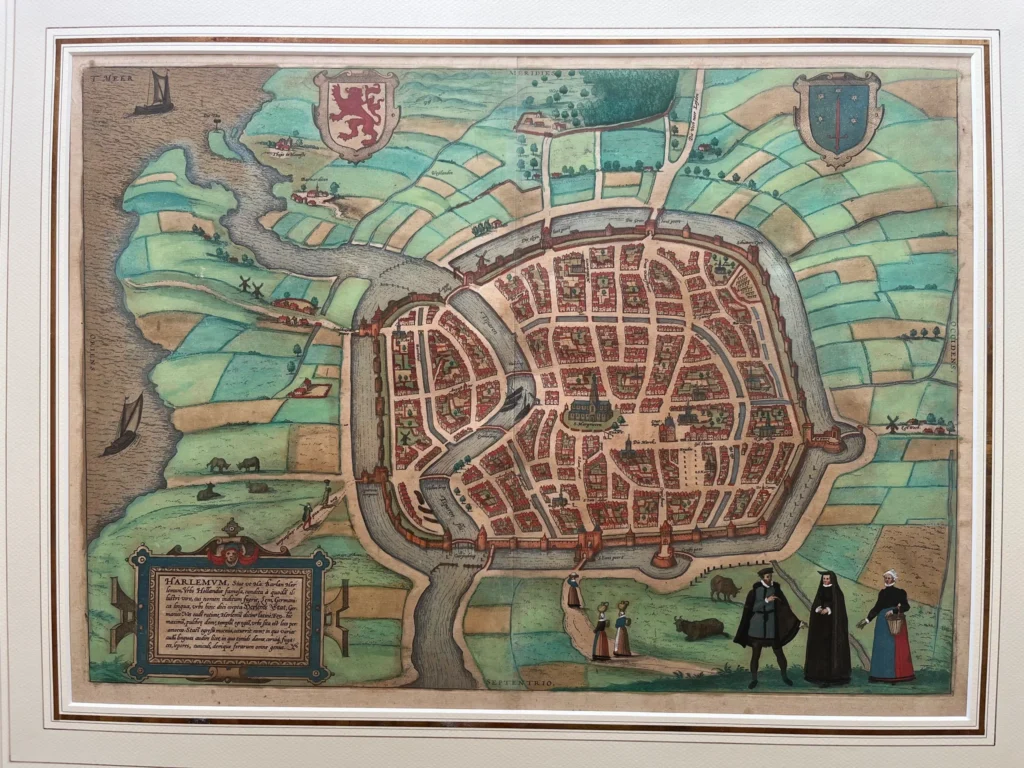
This The Hague Antique Map titled ‘Graven Hage, T’ Hof van Holland’ shows a detailed bird’s‑eye view of the city. Lodovico Guicciardini published this handcoloured engraving in 1610. It depicts the Binnenhof, the Buitenhof, and the Hofvijver, with the coats of arms of Holland and The Hague above the scene.
The engraving measures 23 x 31.5 cm and is handcoloured with fine precision. City streets, waterways, and main buildings appear clearly inside the old fortifications. The design offers both historical insight and decorative appeal typical of early 17th‑century Dutch maps.
This The Hague Antique Map remains in very good condition. It is perfect for collectors of Dutch cartography or early town plans. The print captures The Hague’s character during the Dutch Golden Age with clarity and elegance.
About the Artist: Lodovico Guicciardini
Lodovico Guicciardini (1521–1589) was an Italian writer, merchant, and historian from Florence who lived primarily in Antwerp from the early 1540s. He is best known for his influential book Descrittione di tutti i Paesi Bassi, altrimenti detti Germania inferiore (Description of the Low Countries), first published in 1567. This work provided a detailed account of the history, arts, economy, and cities of the Low Countries (now Belgium, the Netherlands, and Luxembourg), enriched with city maps and views engraved by leading artists of the time.
Guicciardini’s descriptions combined cultural, political, and geographical narratives, making it one of the earliest comprehensive guides to the region. His book was translated into several languages and reprinted over 60 times, significantly shaping European knowledge of the Low Countries in the 16th and 17th centuries. Guicciardini also criticized the effects of the Spanish War on the prosperous region and gave special attention to Antwerp, where he lived.
About the Era: 17th Century (1600s)
The 17th century greatly advanced mapmaking and printmaking, with copperplate engraving enabling cartographers to create detailed and accurate maps. During the Dutch Golden Age, increased trade and exploration boosted the demand for maps, turning map printing into a major industry. Skilled engravers carved designs into copper plates, applied ink, and pressed paper to produce fine prints. After printing, artisans hand-colored maps to enhance their beauty and clarity. Copperplate printing replaced woodcuts, offering smoother lines and finer details. Renowned mapmakers like Blaeu, Janssonius, and Hondius combined scientific knowledge with artistic skill. This era produced remarkable atlases, such as Joan Blaeu’s Atlas Maior. Maps not only charted geography but reflected political power, trade routes, and scientific discoveries. Printed maps became essential for navigation, colonization, and education. Dutch publishers led Europe’s map market, shaping global cartographic standards. These original maps remain prized for their detail and artistry, influencing future mapmaking and holding high value for collectors and museums today.