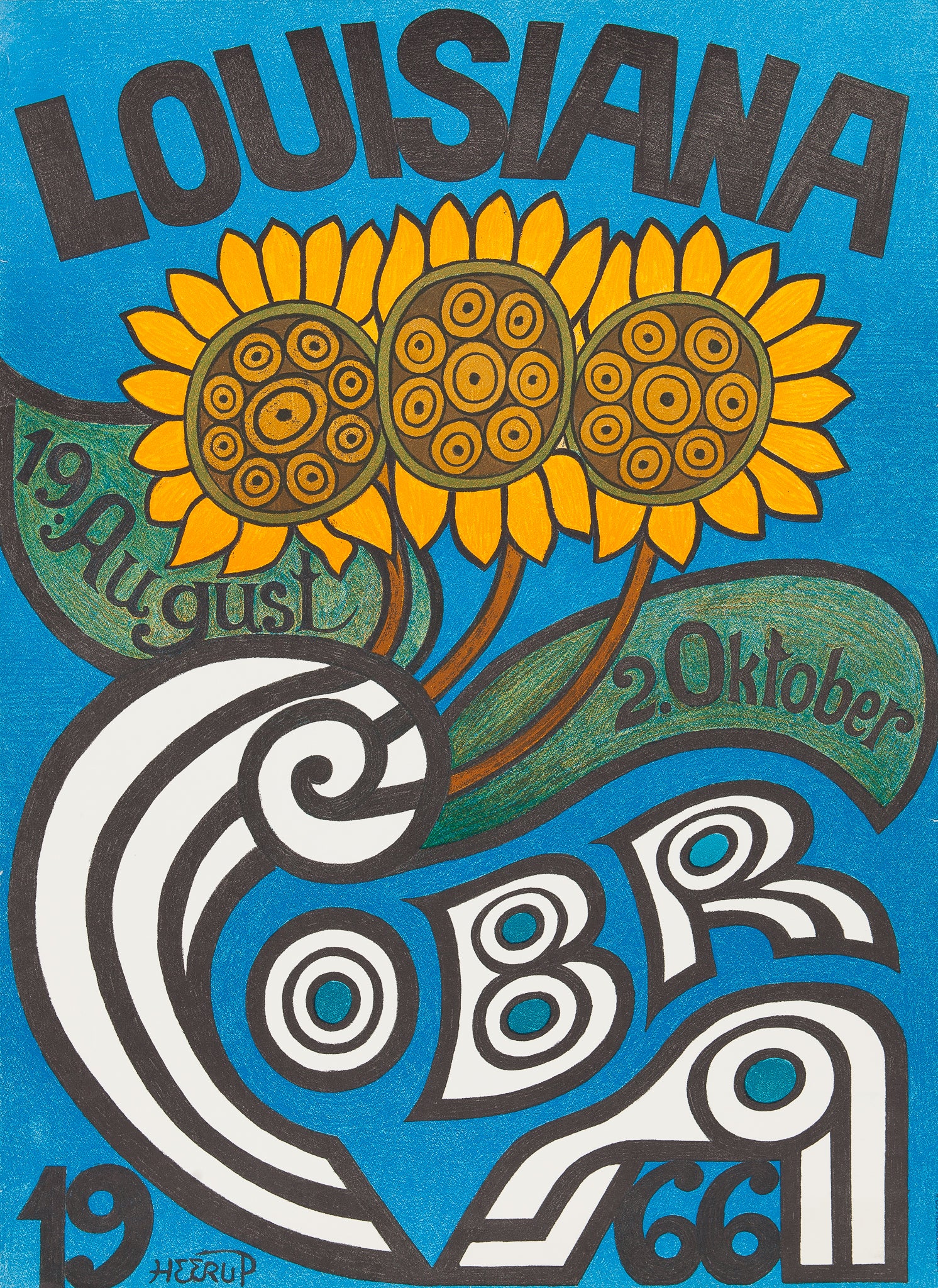
Lithograph by Henry Heerup, 1966
€500.00
This authentic antique print, measuring 64 cm × 86 cm , created by Henry Heerup as a fine example of Lithograph work from the 20th Century (1900s).
It is preserved in Very Good condition and displays remarkable period craftsmanship.
1 in stock
This original lithograph by Henry Heerup is called ‘Louisiana Exhibition 1966.’ It measures 86 by 64 cm and shows Heerup’s unique style from the Cobra art movement. The lithograph is in very good condition with only small creases on the right side. Henry Heerup was a Danish artist known for his colorful and expressive works that mix abstract and figurative elements. This artwork highlights his talent and contribution to mid-20th-century art. It appeals to collectors and fans of the Cobra group’s bold style. Owning this Henry Heerup lithograph means you have a vibrant piece of modern art from a famous artist. It is perfect for display and art appreciation.
Henry Heerup (1907–1993) was a Danish painter, graphic artist, and sculptor known for his versatile and imaginative style. He worked in various media, including painting, lithography, sculpture, and linoleum cuts. Heerup became a member of the Cobra movement, where he contributed vibrant and symbolic artworks inspired by Scandinavian folk art and Nordic archaeology. His art includes playful motifs like elves on bikes and loving couples, capturing the hearts of many. Heerup received several honors, including the Order of the Dannebrog and major Danish art medals. His legacy continues through the Heerup Museum in Rødovre, which exhibits his works and celebrates his impact on Danish art.
The 20th century transformed cartography through technological innovation, global exploration, and the rise of digital mapping. Aerial photography, satellite imagery, and geodesy revolutionized accuracy, replacing centuries-old surveying methods. Governments and international agencies undertook massive mapping projects to support global navigation, aviation, and urban planning. World wars accelerated military cartography, leading to precise topographic and aeronautical charts. Thematic cartography expanded through the use of statistics, enabling social, environmental, and economic maps that visualized complex global data.
Advances in photogrammetry and computer science shifted mapmaking from manual drafting to automated, data-driven production. By the late 20th century, Geographic Information Systems (GIS) redefined how maps were made, stored, and analyzed—introducing dynamic, interactive cartography for both professionals and the public. Atlases, road maps, and educational maps became everyday tools, blending graphic design with geographic accuracy. The 20th century thus marks cartography’s transition from art and measurement to a digital, analytical, and globally integrated discipline—forming the bridge between traditional mapmaking and modern geospatial technology.
| Dimensions | 64 × 86 cm |
|---|---|
| Orientation | |
| Condition | |
| Publish Date | 1966 |
| Technique | Lithograph |
| Artist | |
| Era | |
| Frame | No Frame |
Our antique prints are carefully packaged to ensure safe arrival.
Smaller prints are shipped in acid-free, flat protective packaging, while larger works are securely rolled and sent in a sturdy tube to preserve their condition.
Netherlands: €7.50 —
European Union: €15
Outside the EU: On request (contact us for an exact quote)
We offer custom framing for all prints, from classic antique frames to contemporary minimalist styles.
Choose any print from the collection
We discuss frame styles, materials & pricing
The print will be professionally framed and shipped via courier for maximum safety
If you would like your print framed, please contact us, we are happy to advise on styles and options.
Our highest classification. These prints are clean, bright, and exceptionally well-preserved, featuring a strong and crisp image. No notable imperfections.
Prints in this condition show a clean, sharp image. Paper quality or margin size may vary slightly. Minor age-related characteristics, such as small wormholes, light toning, or tiny separations may be present depending on the print date.
No major imperfections. Any minor flaws or historical repairs are fully noted in the product description. Overall a well-preserved and collectible piece.
These prints show noticeable imperfections such as foxing, weaker image strength, or longer separations, but remain collectible. All visible characteristics are clearly described.