Full Description
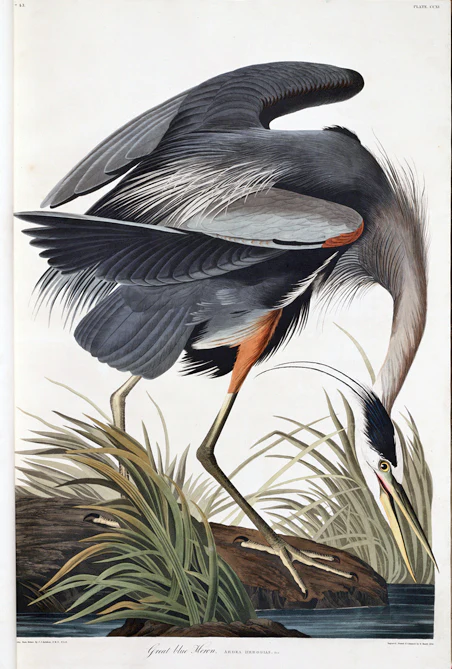
This Audubon Great Blue Heron print is a limited edition Certified Art Giclée on Hahnemuhle White Etching paper. Published in collaboration with the Teylers Museum. Each piece is embossed, numbered, and includes a certificate. The paper size is 100 x 67 cm. First, the originals live in Teylers Museum in Haarlem. This museum owns the only complete Birds of America set in the Netherlands. Victor Gifford Audubon sold it in 1833 for 243 guilders.
Next, John James Audubon made Birds of America from 1827 to 1838. Robert Havell Jr. engraved the life-size prints. About 200 sets exist from that time. Now, 130 are known worldwide. One sold for $8 million at Christie’s in 2011. That’s the third-highest price for a printed book.
Also, archival inks keep colors bright, even in daylight. Audubon painted the Great Blue Heron, North America’s largest heron. Waldemar Fries called Teylers’ copy “probably the finest extant.” Finally, collectors love these facsimiles. They offer museum-quality and value. Hang this Audubon Great Blue Heron print for timeless bird art.
About the Artist: John James Audubon
John James Audubon (1785–1851) was a French-American artist and naturalist. He made detailed, life-size paintings of North American birds. His work combined art and science with bright, lifelike colors. Audubon helped deepen knowledge about birds and nature in America. Collectors prize his work for its beauty and rarity. His art remains a valued part of natural history and fine art.
About the Era: 19th Century (1800s)
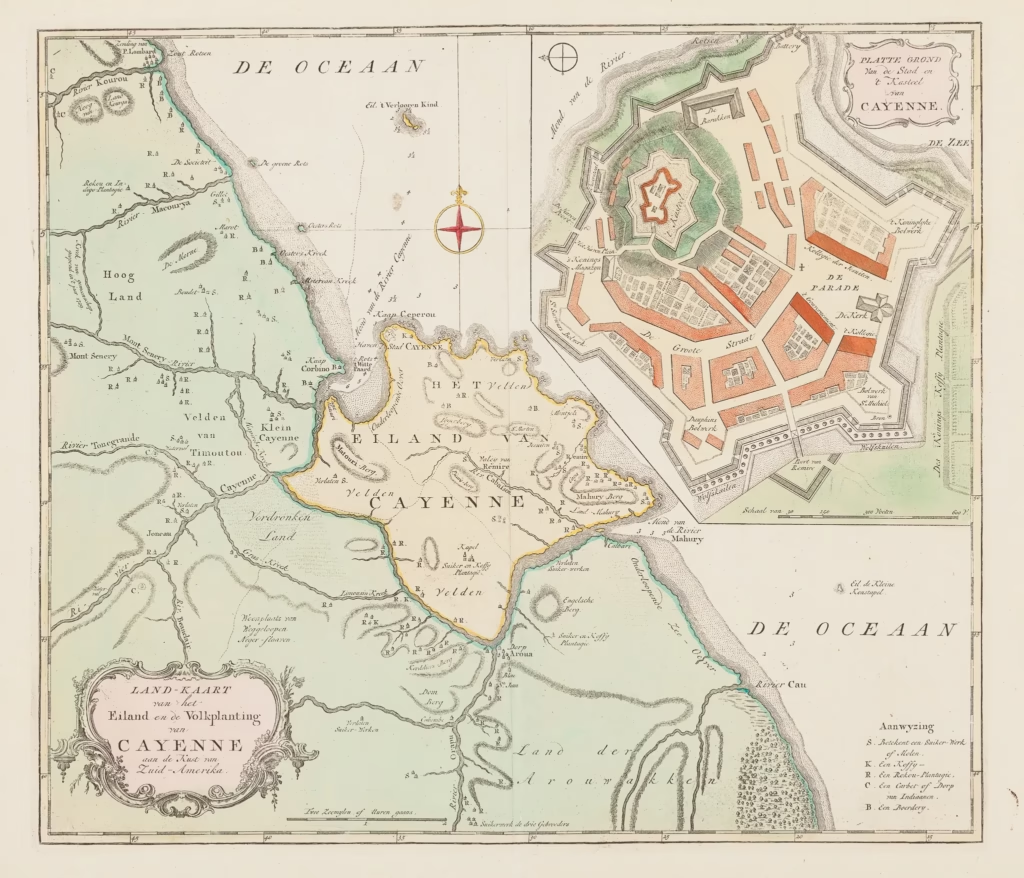
The 19th century marked the era of cartography, as mapmaking became professional, organized, and global. Scientists and surveyors used improved instruments and statistical methods, turning maps into trusted scientific documents with greater precision. Surveying advanced with triangulation, precise tools, and national topographic programs. Printing technology improved, adopting lithography and early color printing to produce clearer, richer maps. New thematic maps used techniques like choropleth, flow lines, and dot density to show data visually. Notably, Charles Minard pioneered multivariate mapping, combining multiple data themes on one map.
Map design reflected industrial and Victorian tastes, balancing detail and readability. Governments supported mapping societies to control territories at home and abroad. Maps became essential for urban planning, empire-building, and scientific research. The 19th century also fostered a global map culture, sharing knowledge internationally. Today, 19th-century maps are prized for their science and artistry. They laid the foundation for modern cartography, data visualization, and geographic information science, and are celebrated by collectors and institutions for their insight into industrial-age geography and culture.