Full Description
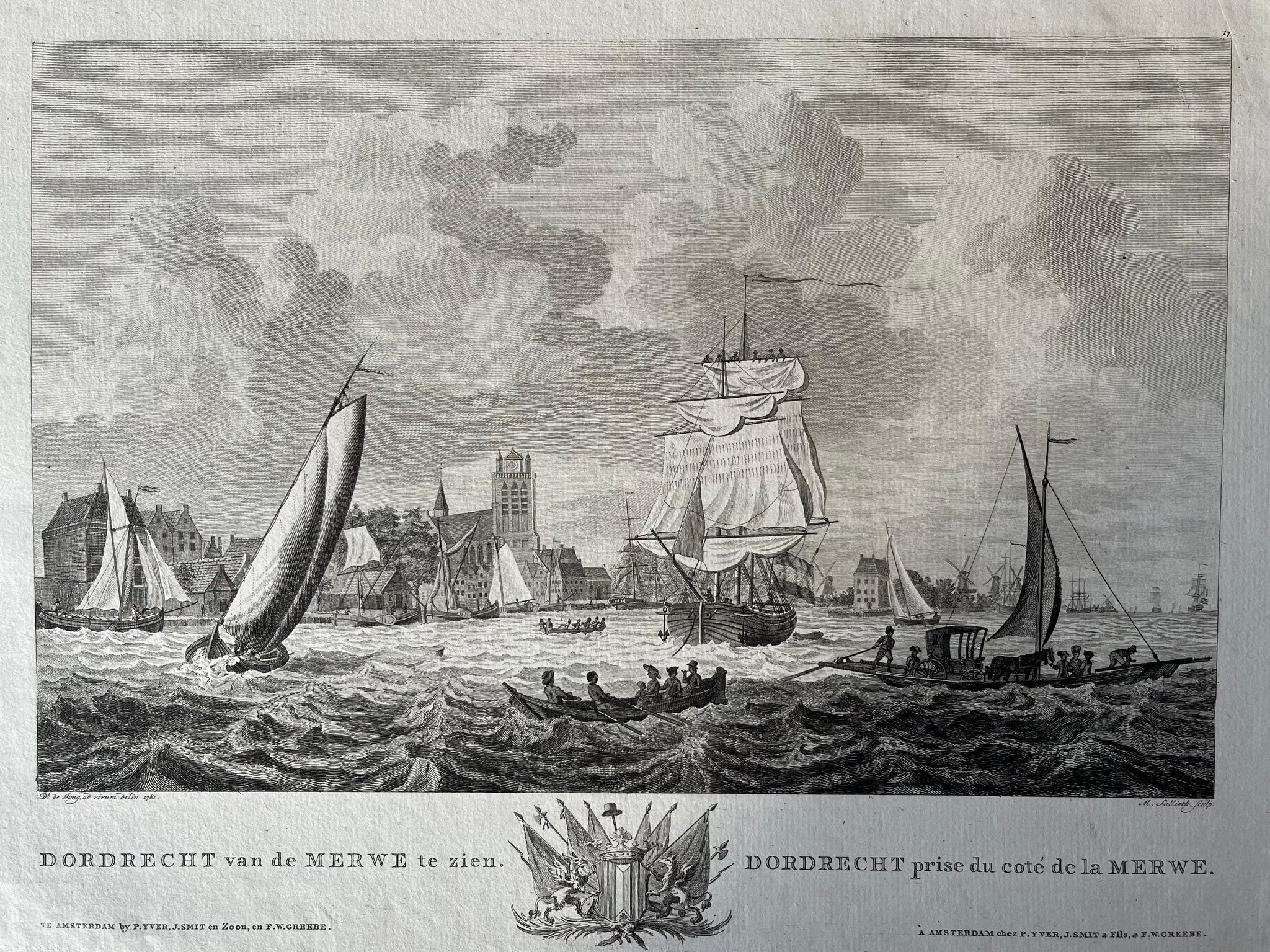
This Dordrecht Harbour Engraving titled ‘Dordrecht van de Merwe te zien || Dordrecht prise du cote de la Merwe’ shows a fine 18th‑century view of Dordrecht seen from the Merwe River. Mathias Sallieth engraved the image after a drawing by Dirk de Jong from 1781. Pieter Yver, J. Smit en Zoon, and F.W. Greebe published it in 1802 in the ‘Atlas van alle de zee-havens der Bataafsche Republiek’.
The engraving measures 28.2 x 38.5 cm and is in very good condition. It presents a calm river scene with sailing ships and Dordrecht’s skyline rising in the background. Clear lines and balanced composition highlight the precision of Dutch marine engraving during this period.
This Dordrecht Harbour Engraving is ideal for collectors of maritime prints and lovers of Dutch city views. It combines historical importance, artistic skill, and the refined atmosphere of Holland’s oldest seaport.
About the Artist: Mathias de Sallieth
Mathias de Sallieth (1749–1791) was a Czech engraver, etcher, and publisher. Born in Prague, he moved to Rotterdam in the Netherlands. He specialized in maritime scenes, harbor views, and detailed etchings of ships and ports. De Sallieth reproduced paintings with copper engravings and stipple techniques. Collectors value his works for their precision and 18th-century artistic quality.
About the Era: 19th Century (1800s)
The 19th century marked the era of cartography, as mapmaking became professional, organized, and global. Scientists and surveyors used improved instruments and statistical methods, turning maps into trusted scientific documents with greater precision. Surveying advanced with triangulation, precise tools, and national topographic programs. Printing technology improved, adopting lithography and early color printing to produce clearer, richer maps. New thematic maps used techniques like choropleth, flow lines, and dot density to show data visually. Notably, Charles Minard pioneered multivariate mapping, combining multiple data themes on one map.
Map design reflected industrial and Victorian tastes, balancing detail and readability. Governments supported mapping societies to control territories at home and abroad. Maps became essential for urban planning, empire-building, and scientific research. The 19th century also fostered a global map culture, sharing knowledge internationally. Today, 19th-century maps are prized for their science and artistry. They laid the foundation for modern cartography, data visualization, and geographic information science, and are celebrated by collectors and institutions for their insight into industrial-age geography and culture.