Full Description
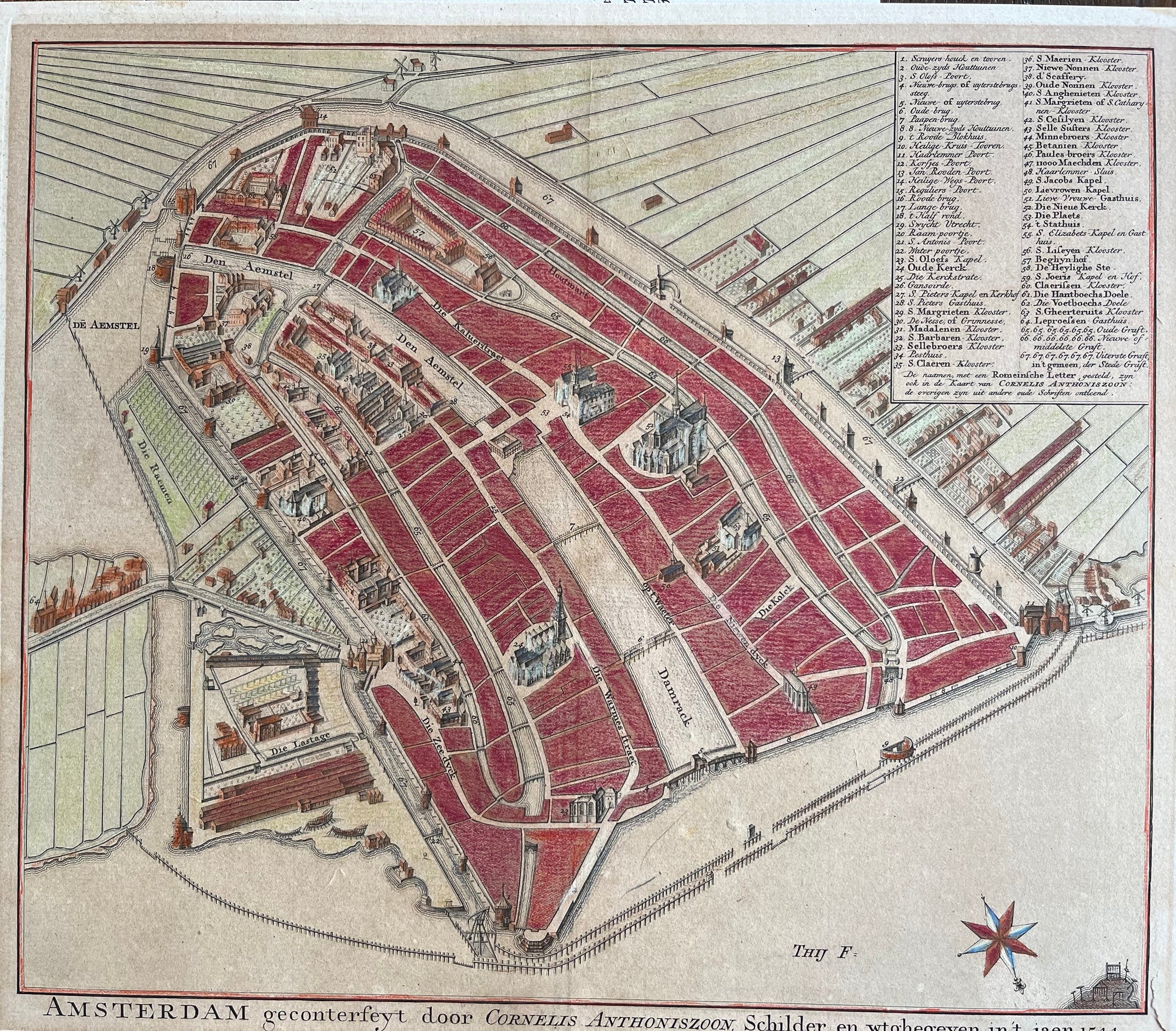
This Cornelis Anthonisz Amsterdam map 1760 is a hand-colored print published by Isaak Tirion and Jan Wagenaar around 1760. It is based on the famous 1544 city plan by Cornelis Anthonisz, known for its detailed bird’s-eye view of early Amsterdam. The map shows the city’s important buildings, canals, and street layout in a classical cartographic style.
Collectors appreciate this map for its warm colouring, historic age tone, and walnut frame, which add charm and authenticity. The 18th-century impression preserves many intricate details of Amsterdam’s early cityscape. It is a beautiful example of Dutch cartography and an excellent historical record of Amsterdam’s development.
This Cornelis Anthonisz Amsterdam map 1760 is a must-have for collectors and history enthusiasts who want to own a piece of Amsterdam’s rich heritage. For more about similar historic maps, explore our collection of Dutch city maps.
About the Artist: Cornelis Anthonisz
Cornelis Anthonisz. (c. 1505–1553) was a Dutch painter, engraver, and mapmaker from Amsterdam. He was the grandson of the painter Jacob Cornelisz van Oostsanen, who likely taught him to paint. Anthonisz is best known for his 1544 woodcut, a bird’s-eye view map of Amsterdam, commissioned by the city as a gift for Charles V. This map was printed in 12 blocks and remained a key representation of the city well into the 17th century. He also created portraits, allegorical prints, and is credited with producing one of the earliest militia group portraits, the 1533 “Banquet of Members of Amsterdam’s Crossbow Civic Guard.” His work is valued for its historical and artistic importance, capturing early 16th-century Amsterdam and advancing Dutch Renaissance art.
About the Era: 18th Century (1700s)
During the 18th century, mapmaking became more scientific and precise. Improved instruments like the telescope and chronometer helped cartographers increase accuracy, shifting maps from decorative art to factual documents. Copperplate engraving stayed as the main printing method, producing fine lines, while hand-coloring added visual impact. French cartographers, such as the Cassini family, led national surveys with geodetic measurements and triangulation, while Dutch mapmakers like Joan Blaeu enhanced printing and atlas quality, ushering in a golden age of atlases.
Maps began including more information and notes to help users, and ornate decorations mostly gave way to scientific clarity, except for cartouches and borders. National and colonial ambitions guided map production to aid navigation and territorial claims. By the late 18th century, large-scale surveys set modern cartography standards. Today, 18th-century maps mix scientific knowledge with artistry, are prized by collectors, and have influenced later cartographic methods. They offer insights into Enlightenment exploration and geography.