Full Description
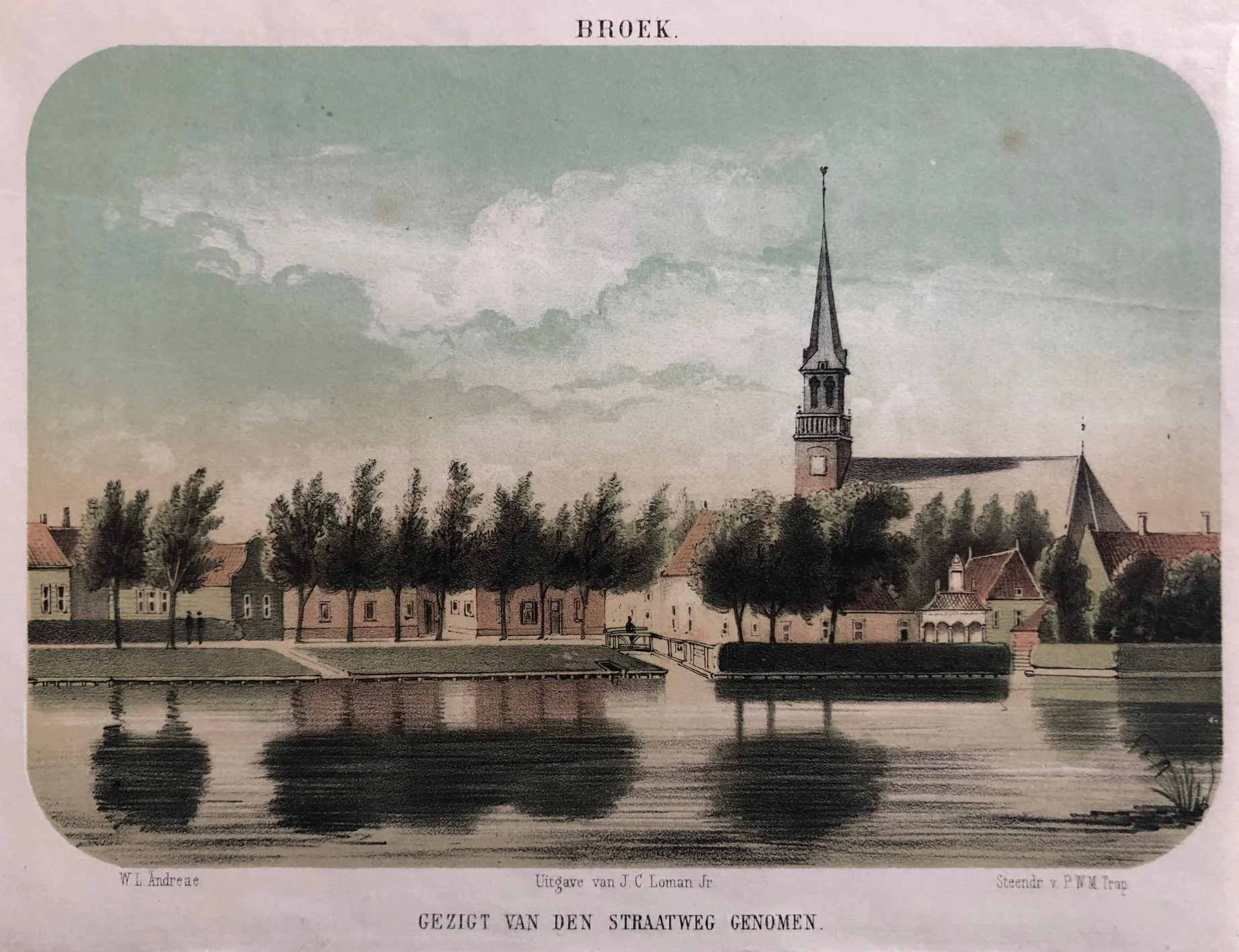
This Broek in Waterland Lithograph titled ‘BROEK, gezigt van den Straatweg genomen’ offers a lovely historic view of the village near Amsterdam. Created by P.W.M. Trap after W.L. Andreae and published by J.C. Loman Jr. in 1857, it features fine hand colouring that adds warmth and depth to the scene. The composition shows the Straatweg with elegant houses, trees, and the church reflected in calm water, capturing the charm of 19th-century Holland.
The lithograph measures 14 x 20.5 cm and is in very good condition, with bright tones and clean margins. Its well-balanced detail and serene atmosphere make it a desirable item for collectors of antique prints or lovers of Dutch scenery. This Broek in Waterland Lithograph beautifully represents the peaceful spirit of Waterland’s countryside and stands as a timeless example of mid-19th century craftsmanship.
Explore our entire collection of City Views, antique maps, Botanical prints and much more at our store located in the historic heart of Haarlem.
About the Artist: Pieter Willem Marinus Trap
Pieter Willem Marinus Trap (1821–1905), was a Dutch lithographer and printer based in Leiden. He created detailed illustrations for scientific books, geological maps, and natural history works. Trap engraved bird plates and historical scenes with precision. His lithographs appear in publications like those by Hermann Schlegel. Collectors value his prints for their technical skill and 19th-century accuracy.
About the Era: 19th Century (1800s)
The 19th century marked the era of cartography, as mapmaking became professional, organized, and global. Scientists and surveyors used improved instruments and statistical methods, turning maps into trusted scientific documents with greater precision. Surveying advanced with triangulation, precise tools, and national topographic programs. Printing technology improved, adopting lithography and early color printing to produce clearer, richer maps. New thematic maps used techniques like choropleth, flow lines, and dot density to show data visually. Notably, Charles Minard pioneered multivariate mapping, combining multiple data themes on one map.
Map design reflected industrial and Victorian tastes, balancing detail and readability. Governments supported mapping societies to control territories at home and abroad. Maps became essential for urban planning, empire-building, and scientific research. The 19th century also fostered a global map culture, sharing knowledge internationally. Today, 19th-century maps are prized for their science and artistry. They laid the foundation for modern cartography, data visualization, and geographic information science, and are celebrated by collectors and institutions for their insight into industrial-age geography and culture.