Full Description
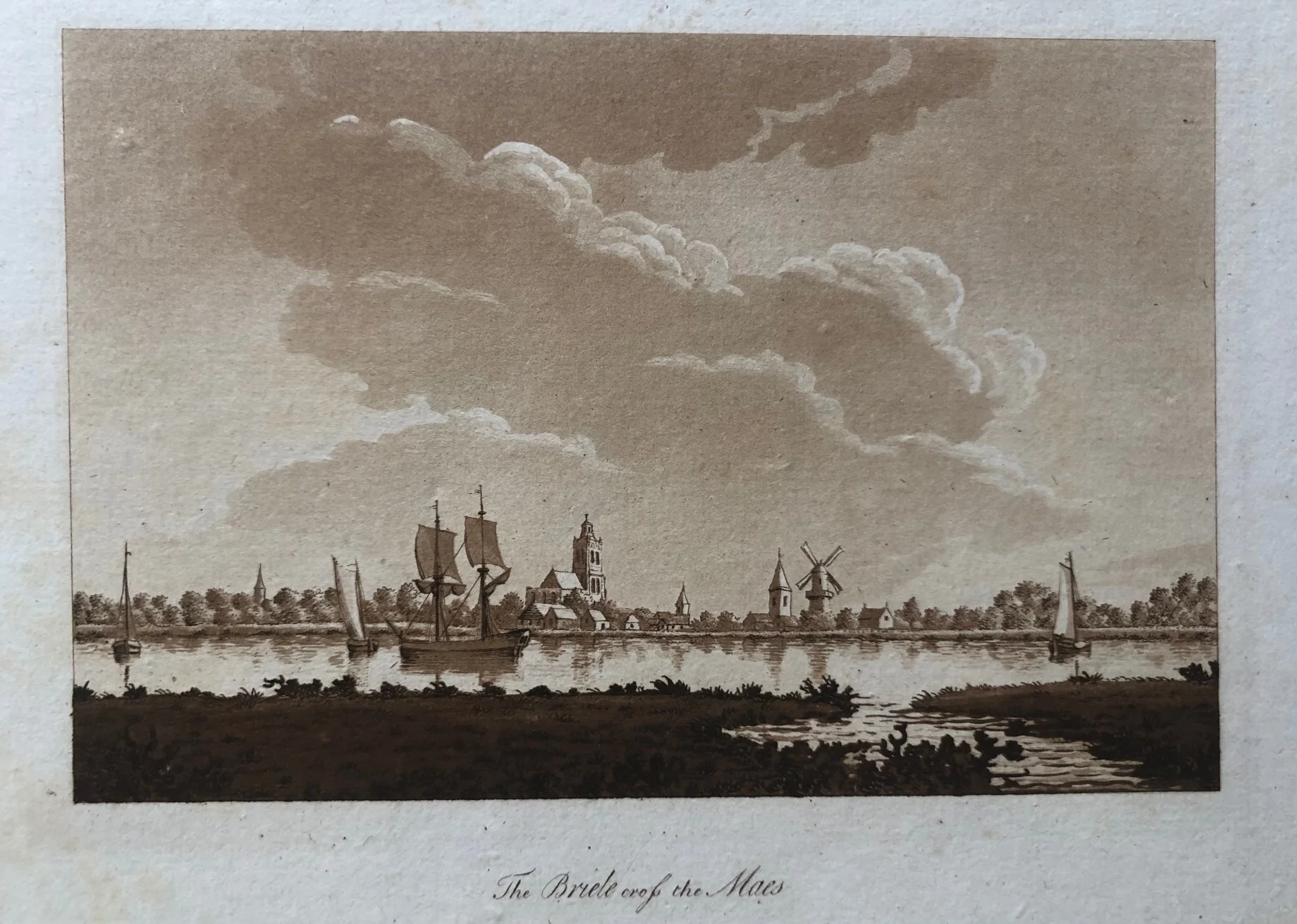
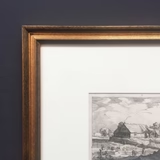
This Brielle Across the Maas Engraving titled ‘The Briele Cross the Maes’ is a beautiful late 18th‑century aquatint view. Published for Samuel Ireland on May 1st, 1790, the sepia tones give the scene warmth and depth. It shows the village of Brielle in South Holland seen across the Maas River, with ships on the water, a windmill, and the church rising in the background. The calm river setting and fine shading create a peaceful atmosphere.
The engraving measures 10.5 x 16 cm and is in very good condition. Its soft tones and delicate linework reflect the refined style of English aquatint printmaking of the period.
This Brielle Across the Maas Engraving is perfect for collectors of Dutch or maritime views. It offers historical interest, artistic harmony, and a glimpse of the quiet beauty of the Dutch riverside in the late 18th century.
About the Artist: Samuel Ireland
Samuel Ireland (1744–1800) was an English author, engraver, and collector best known for his works on art and antiquities. He published books that included detailed engravings and historical accounts, focusing on English landscapes and architecture. Ireland played a key role in documenting cultural heritage in the late 18th century, and collectors value his works for both their artistic and historical significance. He is also noted for his controversial involvement in the Shakespeare forgery scandal.
About the Era: 18th Century (1700s)
During the 18th century, mapmaking became more scientific and precise. Improved instruments like the telescope and chronometer helped cartographers increase accuracy, shifting maps from decorative art to factual documents. Copperplate engraving stayed as the main printing method, producing fine lines, while hand-coloring added visual impact. French cartographers, such as the Cassini family, led national surveys with geodetic measurements and triangulation, while Dutch mapmakers like Joan Blaeu enhanced printing and atlas quality, ushering in a golden age of atlases.
Maps began including more information and notes to help users, and ornate decorations mostly gave way to scientific clarity, except for cartouches and borders. National and colonial ambitions guided map production to aid navigation and territorial claims. By the late 18th century, large-scale surveys set modern cartography standards. Today, 18th-century maps mix scientific knowledge with artistry, are prized by collectors, and have influenced later cartographic methods. They offer insights into Enlightenment exploration and geography.