Full Description
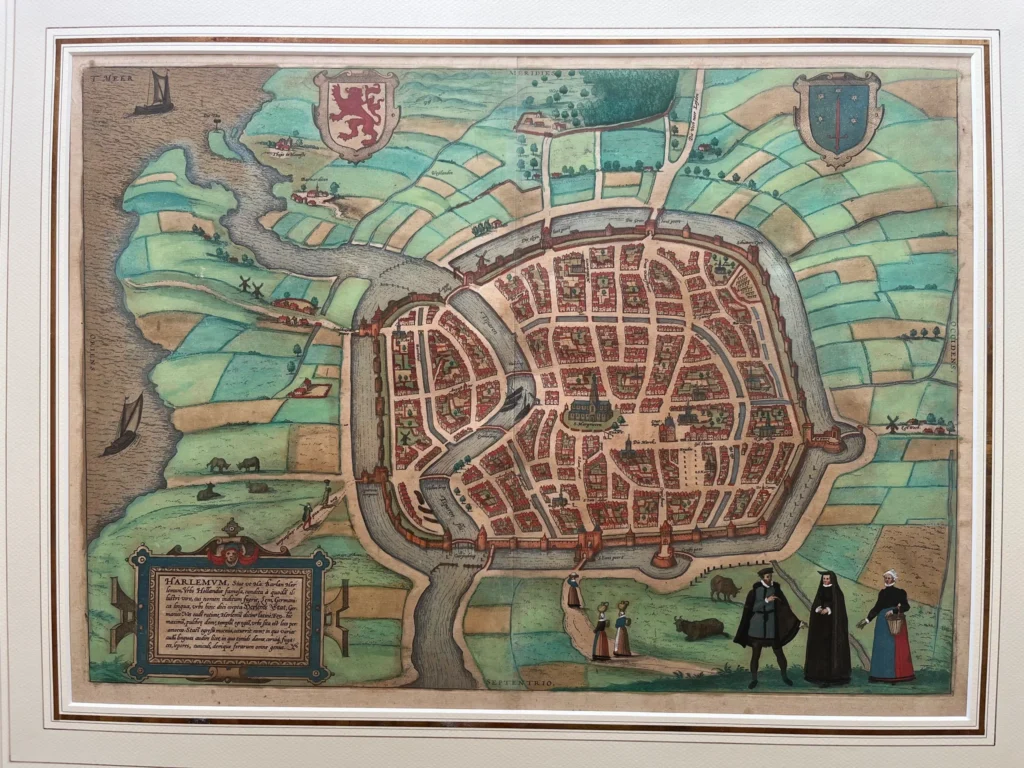
This rare 16th-century hand-colored map shows Ancient Rome through the eyes of the Italian scholar Pirro Ligorio. Published around 1572 in Cologne by Georg Braun and Frans Hogenberg, it is part of their famous city atlas, Civitates Orbis Terrarum. The bird’s-eye view highlights Rome’s ruins and monuments still visible in the 16th century. Important landmarks like the Colosseum, Pantheon, Baths of Caracalla, and Circus Maximus appear labeled in Latin. The map also shows Rome’s hills and riverbanks with great detail.
Pirro Ligorio combined his knowledge of Roman history with artistic skill to create this unusual reconstruction. The copperplate engraving measures 38 by 50 cm and uses vivid hand-coloring on laid paper. It remains in excellent condition, with only minor edge wear and a light centerfold. This map is highly prized by collectors, museums, and scholars interested in Renaissance and ancient Rome. Its mix of classical scholarship with cartographic craftsmanship makes it a standout example of 16th-century mapping. Moreover, it offers a visual journey through Rome’s famous sites, blending historical accuracy with Renaissance art. This piece is ideal for those who appreciate history, map collecting, and classical culture.
About the Artist: Pirro Ligorio
Pirro Ligorio (c. 1512–1583) was a multifaceted Italian Renaissance architect, painter, antiquarian, and garden designer, known for his deep passion for classical Roman antiquity. Ligorio worked as the Vatican’s Papal Architect under Popes Paul IV and Pius IV, notably designing the elaborate fountains at the Villa d’Este in Tivoli. He created detailed frescoes and was a key figure in Renaissance art and architecture in Rome. Ligorio was a skilled cartographer and published a renowned topographical map of ancient Rome, Antiquae urbis imago, in 1561, which was innovative in depicting both famous monuments and vernacular architecture. He also contributed significantly to the preservation and study of Roman antiquities, producing extensive drawings and writings.
Ligorio’s architectural achievements include designing the Papal chapel, the Casino of Pius IV, and fortifications, alongside engineering works like the restoration of the Acqua Vergine aqueduct in Rome. Later, he served as Ducal Antiquary in Ferrara, organizing the ducal library and creating designs for the court. He was recognized for his intellectual contributions and awarded honorary Roman citizenship, a rare honor shared with few Renaissance figures.
About the Era: 16th Century (1500s)
The 16th century saw a strong growth in mapmaking and printmaking. Copperplate engraving revolutionized cartography, helping mapmakers create more detailed and accurate maps. At the same time, exploration, trade, and religious changes increased Europe’s need for reliable maps. Engravers cut designs into copper plates, inked them, and pressed paper to produce clear images. Afterward, artisans hand-colored many maps to enhance their appeal. This method replaced earlier woodcut printing, allowing finer lines and richer details. Influential figures like Marcantonio Raimondi and Gerardus Mercator contributed to this progress, sometimes collaborating or engraving their own maps.
Core innovators Abraham Ortelius, Gerard Mercator, and Jodocus Hondius blended science and art in their atlases. Their maps represented not only geography but also political power and cultural pride, supporting education and navigation. Today, maps from this period remain highly valued for their beauty and historical importance, inspiring future cartographical work and prized by collectors and museums worldwide.