Full Description
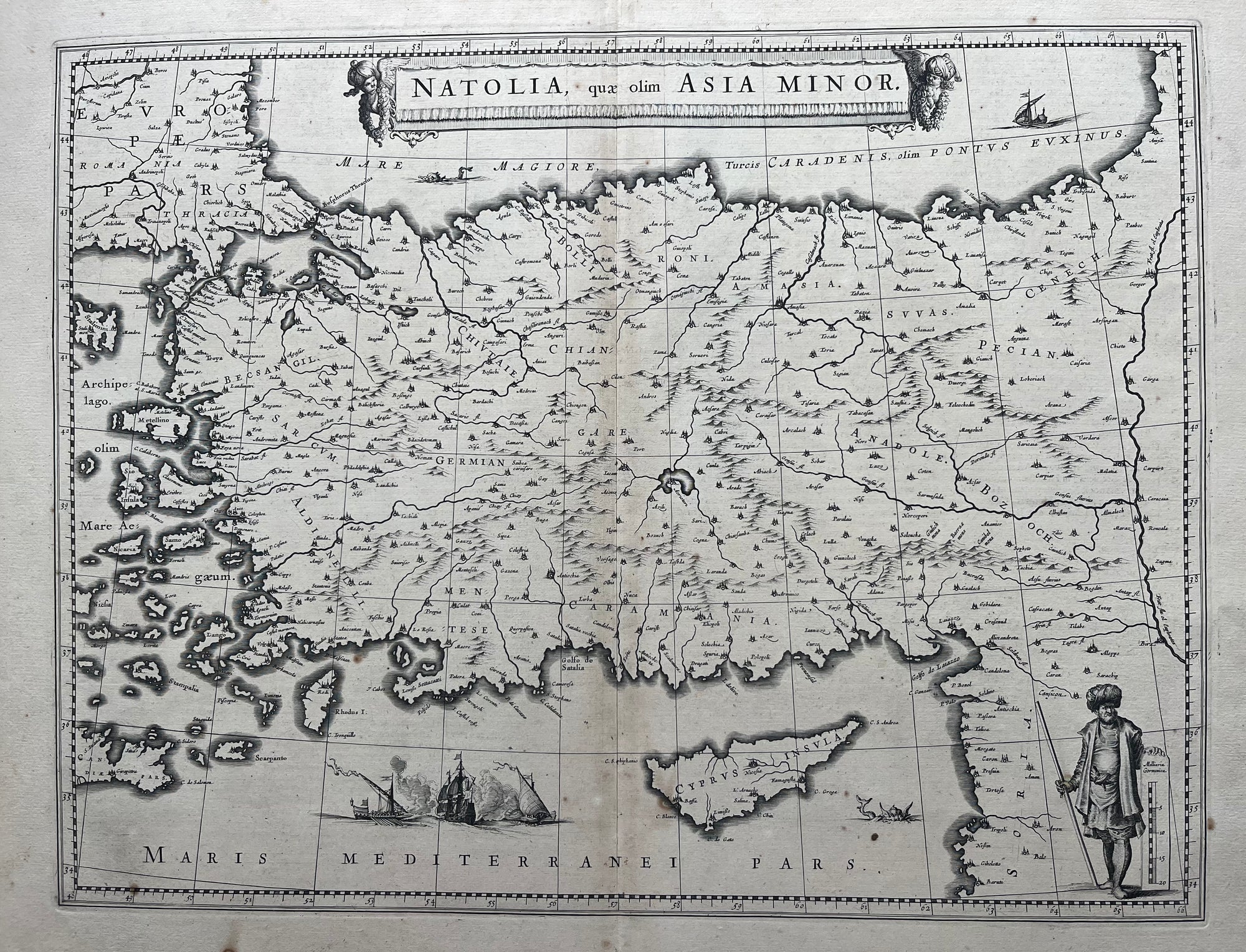
This 17th-century copperplate engraving depicts an Anatolia Asia Minor map, or Anatolia, the Asian part of modern Turkey, published around 1660 by Johannes Janssonius, successor to the Hondius family, showcasing Dutch Golden Age cartographic skill. It covers the region from the Aegean Islands to the Black Sea and Eastern Mediterranean, highlighting ancient Roman provinces like Cilicia, Bithynia, and Lydia.
The Anatolia Asia Minor map features a decorative title cartouche with mythological figures, a richly engraved Mediterranean sea scene with galleons and sea monsters, and a colorful Ottoman figure symbolizing local culture. Measuring 38 by 49.5 cm on laid paper, the engraving is in very good condition with minor aging and a light centerfold crease, and includes Dutch text titled “Kleyn Asien” on the verso. This piece offers a blend of classical and early modern perspectives on Anatolia’s cultural and geographic significance, perfect for collectors and history enthusiasts.
Visit our store located in the historic heart of Haarlem to explore our entire collection.
About the Artist: Gerard Mercator, Johannes Janssonius
Gerardus Mercator (1512–1594) was a Flemish geographer, cartographer, and cosmographer best known for creating the Mercator projection, a groundbreaking map projection introduced in 1569 that represents rhumb lines as straight lines, an invaluable tool for marine navigation.
Born in Rupelmonde, Flanders (now Belgium), he gained early acclaim with maps of Palestine (1537), the world (1538), and Flanders (1539/40). Mercator also produced globes and published a large, detailed map of Europe in 1554. Despite hardships including imprisonment for heresy, he developed a new method of mapmaking that allowed sailors to plot straight-line courses over long distances. He was also the first to publish an atlas as a collection of maps in book form and updated Ptolemy’s maps with corrections and commentary. His innovations significantly advanced cartography during the Renaissance and his legacy persists in modern navigation.
About the Era: 17th Century (1600s)
The 17th century greatly advanced mapmaking and printmaking, with copperplate engraving enabling cartographers to create detailed and accurate maps. During the Dutch Golden Age, increased trade and exploration boosted the demand for maps, turning map printing into a major industry. Skilled engravers carved designs into copper plates, applied ink, and pressed paper to produce fine prints. After printing, artisans hand-colored maps to enhance their beauty and clarity. Copperplate printing replaced woodcuts, offering smoother lines and finer details. Renowned mapmakers like Blaeu, Janssonius, and Hondius combined scientific knowledge with artistic skill. This era produced remarkable atlases, such as Joan Blaeu’s Atlas Maior. Maps not only charted geography but reflected political power, trade routes, and scientific discoveries. Printed maps became essential for navigation, colonization, and education. Dutch publishers led Europe’s map market, shaping global cartographic standards. These original maps remain prized for their detail and artistry, influencing future mapmaking and holding high value for collectors and museums today.