Full Description
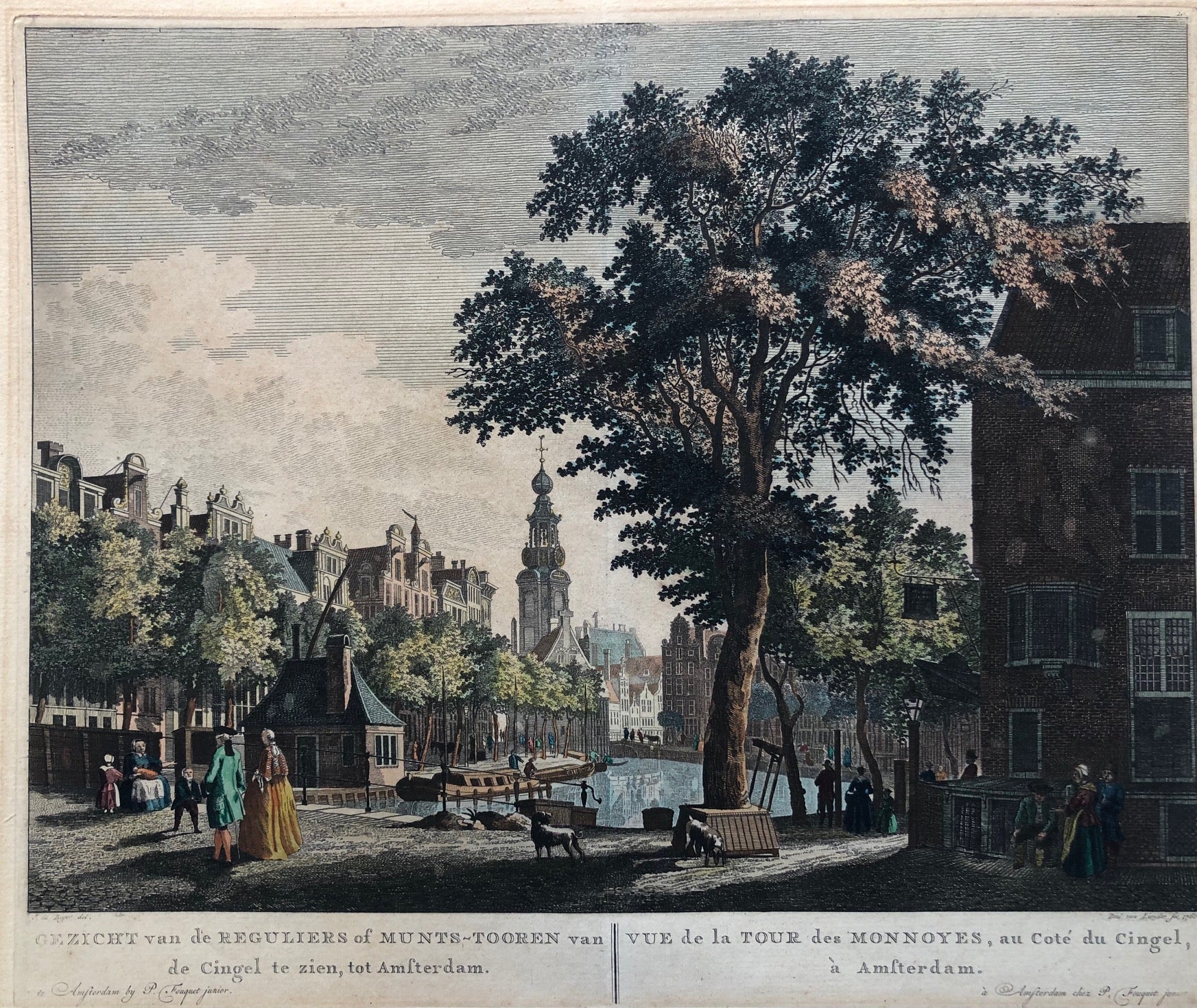
Gezicht van de Reguliers of Munts‑Tooren van de Cingel te zien is a fine handcoloured engraving created in 1760 by Paul van Liender after a drawing by Jan de Beyer. Published by P. Fouquet Junior, the work shows the historic Munttoren and the Singel canal in Amsterdam. The composition captures daily life around the tower with figures, boats, and buildings reflected in the calm water. The fine handcolouring adds warmth and life to the architectural detail.
This Amsterdam Munttoren engraving measures 28.5 x 33.5 cm. The condition is good, with mild browning around the margins that does not affect the image. Collectors appreciate this Amsterdam Munttoren engraving for its artistic craftsmanship, elegant colouring, and authentic 18th‑century view of the city. VAT: Margingoods, no VAT.
About the Artist: Paul van Liender, Willem Steelink
Paul van Liender (1735–1818) was a Dutch landscape painter and engraver. He is known for his finely detailed etchings and drawings of Dutch rural scenes, including forests, rivers, and country estates. Van Liender’s work captures the natural beauty and tranquility of the Dutch countryside in the 18th century. Collectors appreciate his prints for their delicate lines and historic value, reflecting the Romantic movement’s influence on Dutch art.
About the Era: 18th Century (1700s)
During the 18th century, mapmaking became more scientific and precise. Improved instruments like the telescope and chronometer helped cartographers increase accuracy, shifting maps from decorative art to factual documents. Copperplate engraving stayed as the main printing method, producing fine lines, while hand-coloring added visual impact. French cartographers, such as the Cassini family, led national surveys with geodetic measurements and triangulation, while Dutch mapmakers like Joan Blaeu enhanced printing and atlas quality, ushering in a golden age of atlases.
Maps began including more information and notes to help users, and ornate decorations mostly gave way to scientific clarity, except for cartouches and borders. National and colonial ambitions guided map production to aid navigation and territorial claims. By the late 18th century, large-scale surveys set modern cartography standards. Today, 18th-century maps mix scientific knowledge with artistry, are prized by collectors, and have influenced later cartographic methods. They offer insights into Enlightenment exploration and geography.