Full Description
This Alcea Sylvestris Botanical Engraving titled ‘Alcea Sylvestris rubra, b. Alcea Sylvestr: flore pallido. Mauve Sauvage’ shows two elegant wild mallow varieties. Johann Wilhelm Weinmann created the plate for his famous Phytanthoza Iconographia, published in 1737.
The sheet measures 32.4 x 21.1 cm. Weinmann printed the image in colour and then enhanced it by hand. The tones remain bright, and the petals and leaves stand out in lifelike depth thanks to the mezzotint technique. His precision and rich shading make this one of his most admired botanical works.
This Alcea Sylvestris Botanical Engraving is in very good condition. It suits collectors who appreciate 18th‑century botanical art for its accuracy, artistry, and timeless beauty. Each detail shows Weinmann’s dedication to combining science and aesthetics in perfect harmony.
About the Artist: Johann Wilhelm Weinmann
Johann Wilhelm Weinmann (1683–1741) was a German apothecary and botanist best known for creating the florilegium Phytanthoza iconographia between 1737 and 1745. Born in Gardelegen, he settled in Regensburg as an apothecary, where his flourishing business allowed him to pursue his botanical interests. Weinmann established a botanical garden and published several works on medicinal plants.
His Phytanthoza iconographia is an ambitious illustrated botanical series consisting of eight folio volumes with over 1,000 hand-colored engravings of thousands of plants. This work employed notable illustrators such as Georg Dionysius Ehret and used innovative mezzotint printing techniques. The florilegium is highly regarded for its artistic quality and accuracy and influenced botanical illustration significantly.
About the Era: 18th Century (1700s)
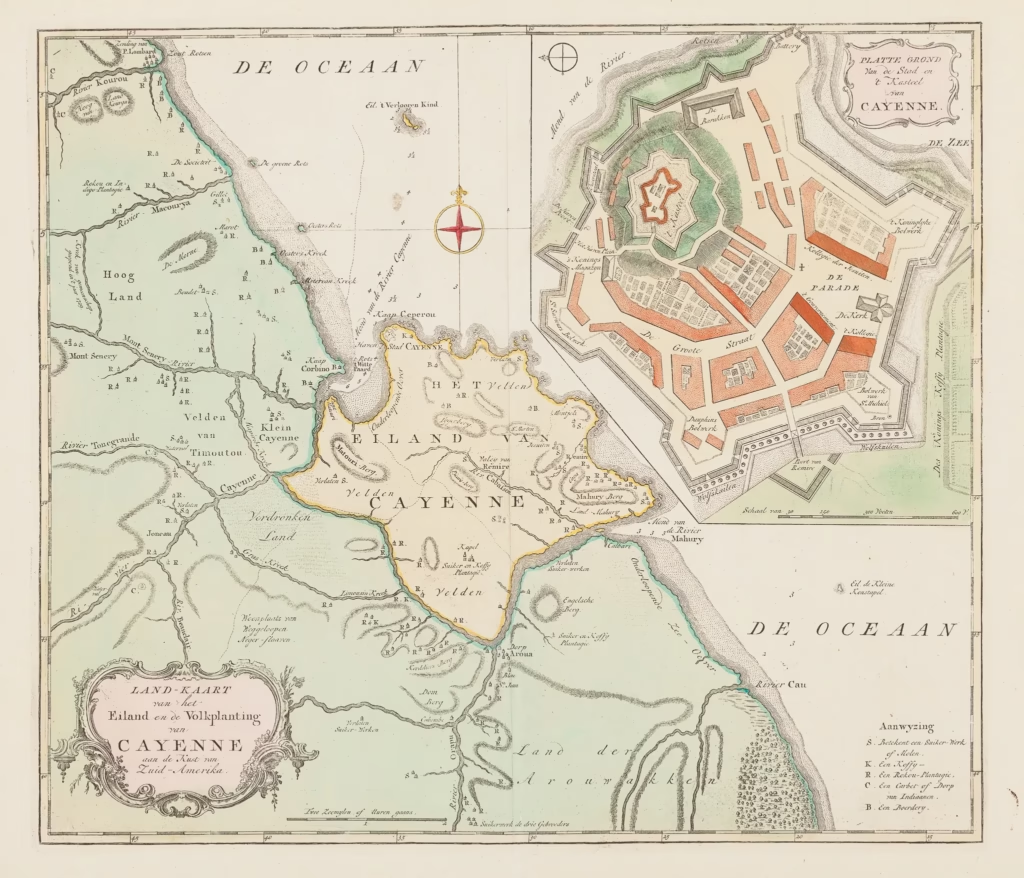
During the 18th century, mapmaking became more scientific and precise. Improved instruments like the telescope and chronometer helped cartographers increase accuracy, shifting maps from decorative art to factual documents. Copperplate engraving stayed as the main printing method, producing fine lines, while hand-coloring added visual impact. French cartographers, such as the Cassini family, led national surveys with geodetic measurements and triangulation, while Dutch mapmakers like Joan Blaeu enhanced printing and atlas quality, ushering in a golden age of atlases.
Maps began including more information and notes to help users, and ornate decorations mostly gave way to scientific clarity, except for cartouches and borders. National and colonial ambitions guided map production to aid navigation and territorial claims. By the late 18th century, large-scale surveys set modern cartography standards. Today, 18th-century maps mix scientific knowledge with artistry, are prized by collectors, and have influenced later cartographic methods. They offer insights into Enlightenment exploration and geography.