Full Description
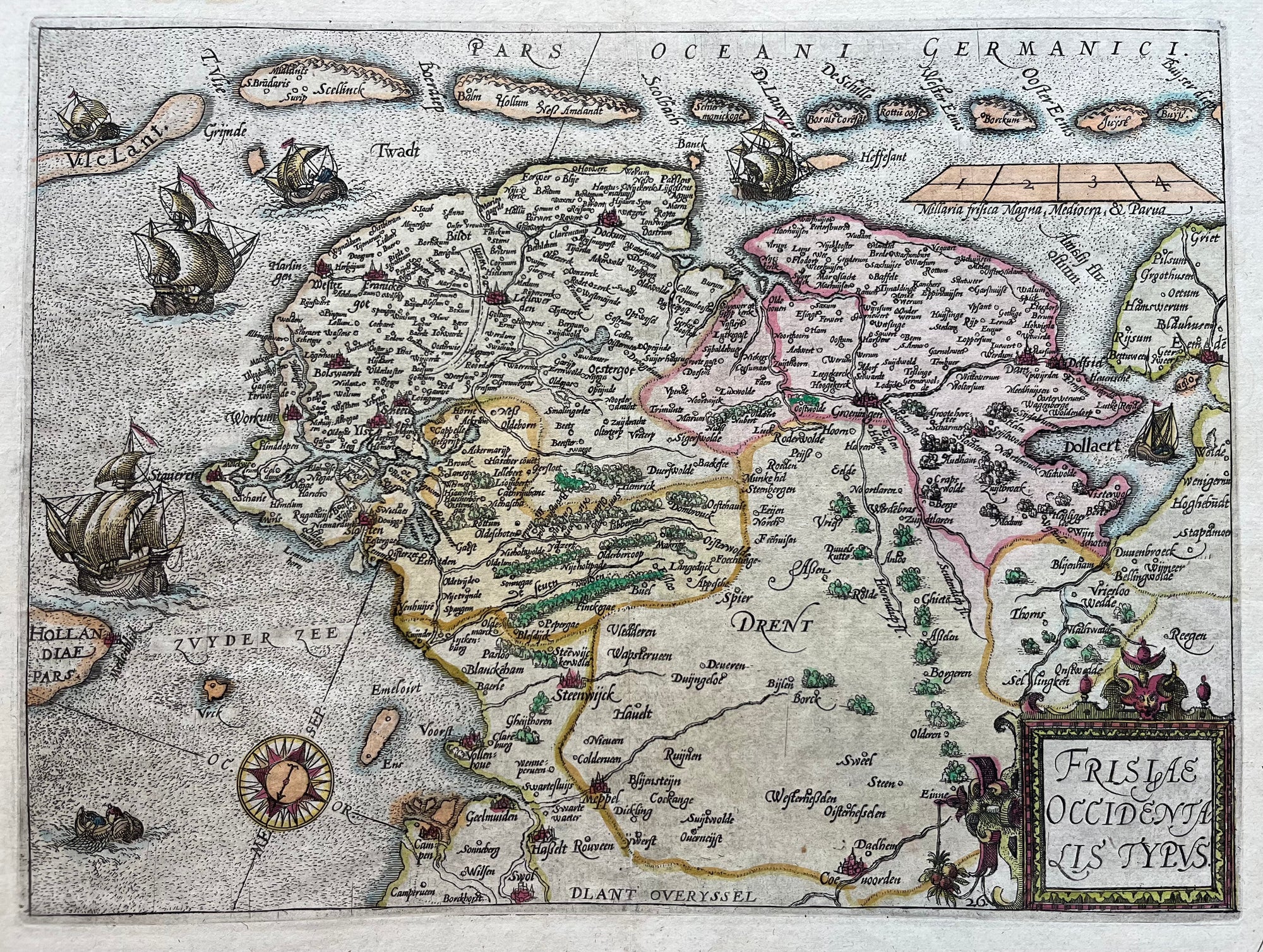
This antique map of Friesland is a beautifully hand-colored print from the late 16th century by Lodovico Guicciardini. Christoffel Plantijn published this important map in Antwerp between 1582 and 1588. The map details Friesland, Groningen, and Drenthe, highlighting coastal features, islands, and early Dutch settlements.
Collectors prize this map for its vibrant colors and historical significance. The condition is very good, with the map’s decorative and topographical details clearly visible. Guicciardini’s careful engraving and Plantijn’s expert publishing have preserved a valuable visual record of the region from the Renaissance era.
If you are interested in Dutch cartography or historical maps, this antique map of Friesland is an excellent addition to your collection. Explore our catalogue of historic Dutch maps for other rare prints by Plantijn and his contemporaries.
About the Artist: Lodovico Guicciardini
Lodovico Guicciardini (1521–1589) was an Italian writer, merchant, and historian from Florence who lived primarily in Antwerp from the early 1540s. He is best known for his influential book Descrittione di tutti i Paesi Bassi, altrimenti detti Germania inferiore (Description of the Low Countries), first published in 1567. This work provided a detailed account of the history, arts, economy, and cities of the Low Countries (now Belgium, the Netherlands, and Luxembourg), enriched with city maps and views engraved by leading artists of the time.
Guicciardini’s descriptions combined cultural, political, and geographical narratives, making it one of the earliest comprehensive guides to the region. His book was translated into several languages and reprinted over 60 times, significantly shaping European knowledge of the Low Countries in the 16th and 17th centuries. Guicciardini also criticized the effects of the Spanish War on the prosperous region and gave special attention to Antwerp, where he lived.
About the Era: 16th Century (1500s)
The 16th century saw a strong growth in mapmaking and printmaking. Copperplate engraving revolutionized cartography, helping mapmakers create more detailed and accurate maps. At the same time, exploration, trade, and religious changes increased Europe’s need for reliable maps. Engravers cut designs into copper plates, inked them, and pressed paper to produce clear images. Afterward, artisans hand-colored many maps to enhance their appeal. This method replaced earlier woodcut printing, allowing finer lines and richer details. Influential figures like Marcantonio Raimondi and Gerardus Mercator contributed to this progress, sometimes collaborating or engraving their own maps.
Core innovators Abraham Ortelius, Gerard Mercator, and Jodocus Hondius blended science and art in their atlases. Their maps represented not only geography but also political power and cultural pride, supporting education and navigation. Today, maps from this period remain highly valued for their beauty and historical importance, inspiring future cartographical work and prized by collectors and museums worldwide.