Full Description
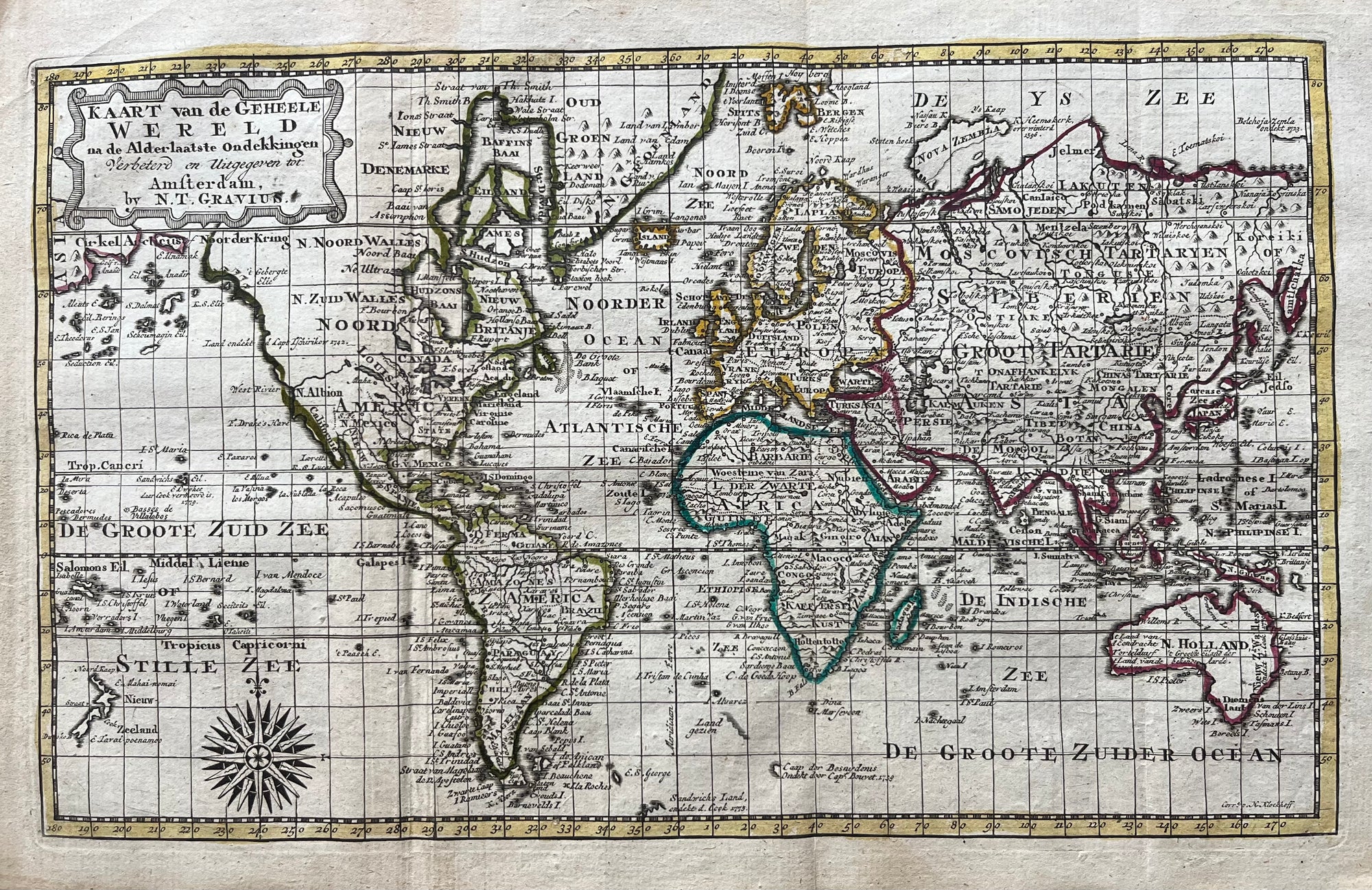
This rare 1789 world map by Gravius was engraved and published in Amsterdam. It is based on a design by Jacob de Keizer and corrected by N. Klockhoff. This finely handcoloured engraving marks a turning point in late 18th-century cartography. It captures the latest discoveries and global knowledge of that era.
The map clearly shows New Zealand fully outlined. The eastern coastline of Australia (Nieuw Holland) forms following Captain James Cook’s second voyage. Tasmania still appears attached to the mainland, reflecting an earlier view of the region. Captain Cook’s death in Hawaii (1779) is distinctly marked, adding historical significance.
In North America, the engraving features the rare “River of the West” extending deep inland. The newly formed United States appears labeled as “Vereen State,” stretching westward to the Mississippi River.
Handcoloured in period tones and drawn on a Mercator projection, this compact yet detailed map offers both visual appeal and scholarly value. Holding the world map by Gravius is a valuable treasure for collectors of early world maps and explorers of historical cartography.
About the Artist: H. Klockhoff, Jacob de Keizer
H. Klockhoff, also known as Hendrik Klockhoff, was an Amsterdam-based engraver active in the latter part of the 18th century, approximately between 1777 and 1798. He is known for his detailed engraving work on maps and views, including some of the earliest maps recognizing the newly independent United States. Klockhoff’s work is respected for its technical skill and contribution to Dutch cartographic traditions during this period. His engravings often appeared in atlases and geographical publications, and he was involved in producing finely engraved title pages and numerous views related to Dutch maritime and trade themes, reflecting the cartographic and artistic interests of his time.
About the Era: 18th Century (1700s)
During the 18th century, mapmaking became more scientific and precise. Improved instruments like the telescope and chronometer helped cartographers increase accuracy, shifting maps from decorative art to factual documents. Copperplate engraving stayed as the main printing method, producing fine lines, while hand-coloring added visual impact. French cartographers, such as the Cassini family, led national surveys with geodetic measurements and triangulation, while Dutch mapmakers like Joan Blaeu enhanced printing and atlas quality, ushering in a golden age of atlases.
Maps began including more information and notes to help users, and ornate decorations mostly gave way to scientific clarity, except for cartouches and borders. National and colonial ambitions guided map production to aid navigation and territorial claims. By the late 18th century, large-scale surveys set modern cartography standards. Today, 18th-century maps mix scientific knowledge with artistry, are prized by collectors, and have influenced later cartographic methods. They offer insights into Enlightenment exploration and geography.