Hand-colored engraving by Smient–Rieuwertsz, 1664
€400.00
This authentic antique print, measuring 25 cm × 24.5 cm , created by Smient–Rieuwertsz as a fine example of Hand-colored engraving work from the 17th Century (1600s).
Published by Smient–Rieuwertsz, it is preserved in Very Good condition and displays remarkable period craftsmanship.
1 in stock
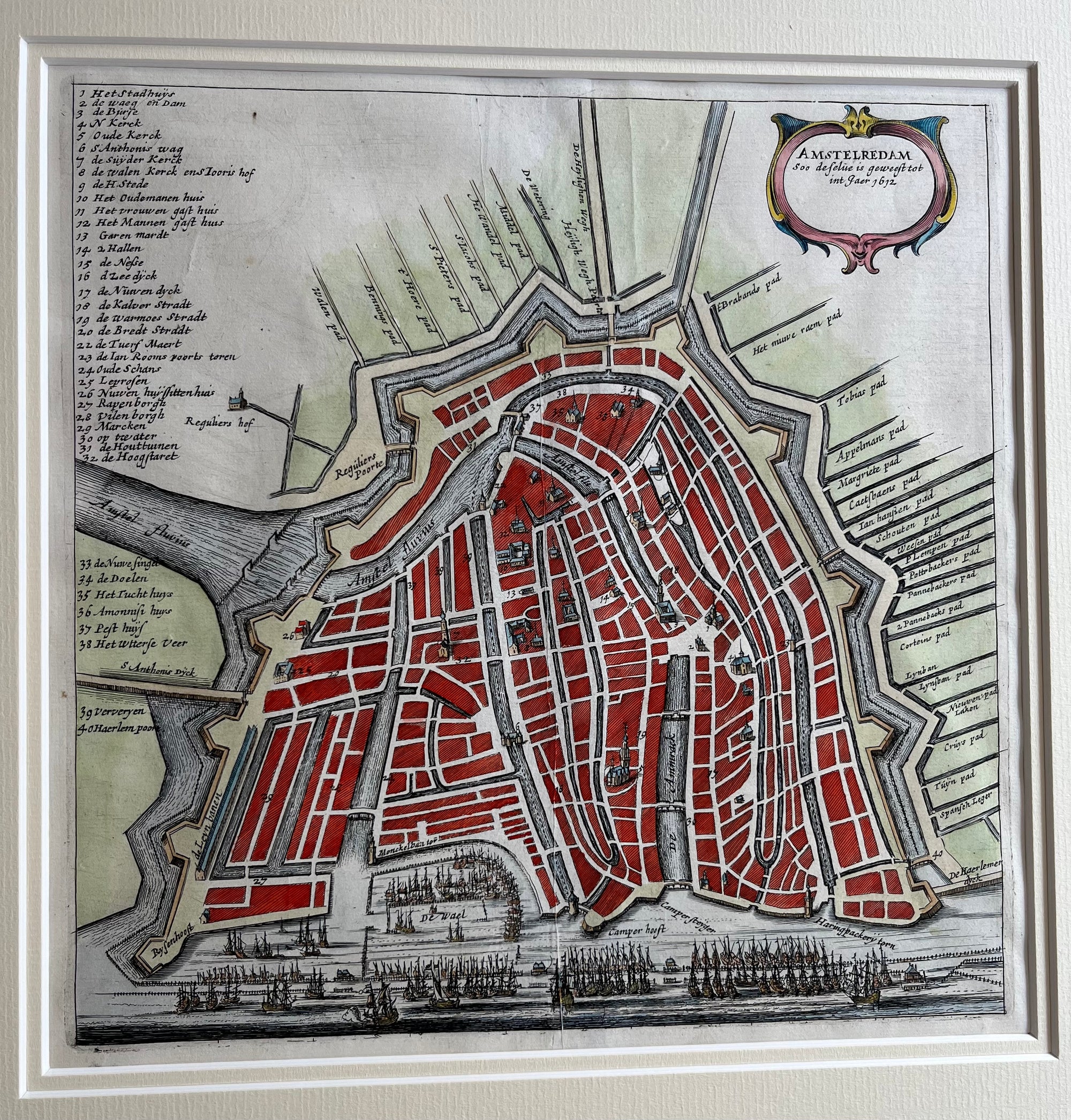
This Antique Map of Amsterdam (1612 View) is a beautifully detailed engraving titled ‘Amstelredam Soo deselve is geweest tot int Jaer 1612’. It was published by Smient–Rieuwertsz and highlights the city’s layout in the early 17th century.
The map features footpaths outside the city walls, bustling ships on the IJ, and the Reguliershof on the left. Hand-colouring enhances the intricate details, bringing the historic cityscape to life. It is preserved with a strong, clean impression and elegantly framed in walnut.
This antique map is a valuable piece for collectors of Dutch cartography and historic city views. It is referenced in Hameleers Cat. 57 and D’Ailly nr. 91.
Explore more historic Dutch maps in our collection. Visit our store in the heart of Haarlem.
Family Background and Contributions
The Smient and Rieuwertsz families played important roles in Dutch cartography and publishing during the 17th century. They belonged to interconnected circles of mapmakers, engravers, and publishers active in Amsterdam, a hub of cartographic innovation and print production.
The Rieuwertsz family, notably Jan Rieuwertsz Sr. (ca. 1617-1687), collaborated with various scholars and printers, influencing the spread of cartographic and scholarly works. Their publishing house was involved in producing geographic texts linked to Dutch colonial activity, trade, and scientific exploration.
While less documented, the Smient family was part of the broader network of Dutch cartographers and book traders, contributing to the dissemination of maps and atlases. Both families embodied the early modern digital media ecosystem of print, distribution, and intellectual exchange.
Historical Impact
Together, these families contributed to the golden age of Dutch cartography by supporting the publication of atlases, city plans, and scientific maps used in navigation, trade, and scholarship. Their work helped establish Dutch prints as some of the most detailed and artistically renowned of their time.
Key Characteristics
Active during the 17th century Dutch Golden Age in Amsterdam
Publishers and distributors of cartographic and scholarly works
Connected to prominent mapmakers and scholars of the time
Played roles in spreading knowledge about the Dutch colonial empire and European geography

The 17th century greatly advanced mapmaking and printmaking, with copperplate engraving enabling cartographers to create detailed and accurate maps. During the Dutch Golden Age, increased trade and exploration boosted the demand for maps, turning map printing into a major industry. Skilled engravers carved designs into copper plates, applied ink, and pressed paper to produce fine prints. After printing, artisans hand-colored maps to enhance their beauty and clarity. Copperplate printing replaced woodcuts, offering smoother lines and finer details. Renowned mapmakers like Blaeu, Janssonius, and Hondius combined scientific knowledge with artistic skill. This era produced remarkable atlases, such as Joan Blaeu’s Atlas Maior. Maps not only charted geography but reflected political power, trade routes, and scientific discoveries. Printed maps became essential for navigation, colonization, and education. Dutch publishers led Europe’s map market, shaping global cartographic standards. These original maps remain prized for their detail and artistry, influencing future mapmaking and holding high value for collectors and museums today.
| Dimensions | 25 × 24.5 cm |
|---|---|
| Artist | |
| Condition | |
| Era | |
| Frame | Walnut frame |
| Orientation | |
| Publish Date | 1664 |
| Published by | Smient–Rieuwertsz |
| Technique | Hand-colored engraving |
Our antique prints are carefully packaged to ensure safe arrival.
Smaller prints are shipped in acid-free, flat protective packaging, while larger works are securely rolled and sent in a sturdy tube to preserve their condition.
Netherlands: €7.50 —
European Union: €15
Outside the EU: On request (contact us for an exact quote)
We offer custom framing for all prints, from classic antique frames to contemporary minimalist styles.
Choose any print from the collection
We discuss frame styles, materials & pricing
The print will be professionally framed and shipped via courier for maximum safety
If you would like your print framed, please contact us, we are happy to advise on styles and options.
Our highest classification. These prints are clean, bright, and exceptionally well-preserved, featuring a strong and crisp image. No notable imperfections.
Prints in this condition show a clean, sharp image. Paper quality or margin size may vary slightly. Minor age-related characteristics, such as small wormholes, light toning, or tiny separations may be present depending on the print date.
No major imperfections. Any minor flaws or historical repairs are fully noted in the product description. Overall a well-preserved and collectible piece.
These prints show noticeable imperfections such as foxing, weaker image strength, or longer separations, but remain collectible. All visible characteristics are clearly described.