Full Description
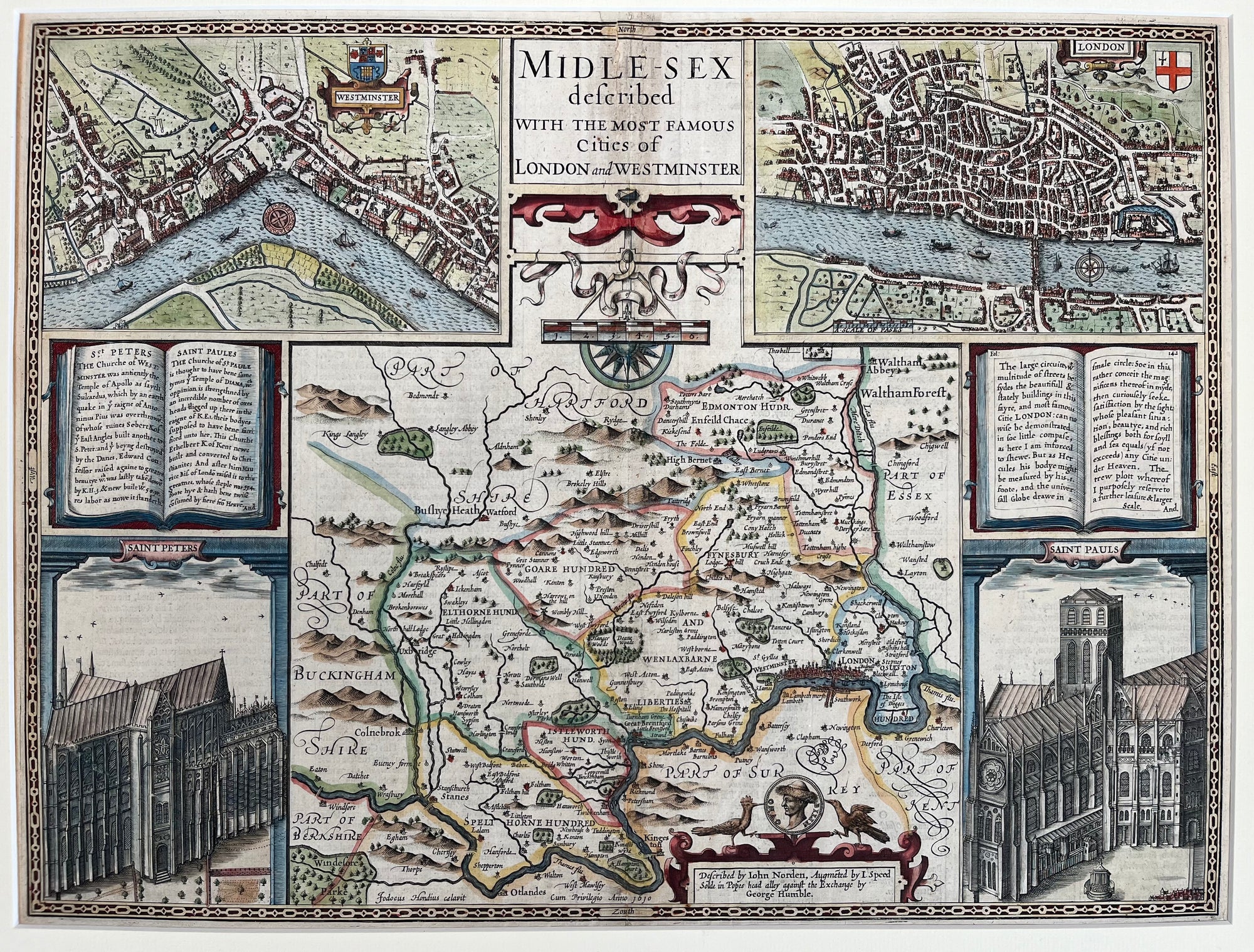
This John Speed Middlesex map was published around 1627 by George Humble. It shows the county of Middlesex with detailed inset plans of London and Westminster. The map features views of St. Peter’s and St. Paul’s.
Speed was a renowned English cartographer known for his early detailed county maps. This map exemplifies early English cartography with delicate hand-colouring and clear engraving. It is a prized piece for collectors of John Speed maps, UK counties, and early London geography.
The map reflects historical and geographical knowledge of the time, combining artistic skill with informative content. It remains in very good condition, making it a beautiful addition to any collection.
Explore our collection of English maps or visit our store in the heart of Haarlem.
About the Artist: John Speed
John Speed (1551/52–1629) was an English cartographer, historian, and chronologer from Cheshire. Starting his career as a tailor, Speed developed a keen interest in history, geography, and cartography. With patronage from Sir Fulke Greville and others, he published The Theatre of the Empire of Great Britaine (1611), a groundbreaking atlas featuring detailed county maps of England, Wales, Scotland, and Ireland. Speed improved upon earlier maps by incorporating detailed town plans and hundred-boundaries, many surveyed by himself. His maps combined geographic detail with historical, heraldic, and genealogical information. His work played a significant role in defining early modern British national identity and influenced English cartography for centuries. Although not an engraver himself, he collaborated with engravers like Jodocus Hondius to ensure high-quality production.
About the Era: 17th Century (1600s)
The 17th century greatly advanced mapmaking and printmaking, with copperplate engraving enabling cartographers to create detailed and accurate maps. During the Dutch Golden Age, increased trade and exploration boosted the demand for maps, turning map printing into a major industry. Skilled engravers carved designs into copper plates, applied ink, and pressed paper to produce fine prints. After printing, artisans hand-colored maps to enhance their beauty and clarity. Copperplate printing replaced woodcuts, offering smoother lines and finer details. Renowned mapmakers like Blaeu, Janssonius, and Hondius combined scientific knowledge with artistic skill. This era produced remarkable atlases, such as Joan Blaeu’s Atlas Maior. Maps not only charted geography but reflected political power, trade routes, and scientific discoveries. Printed maps became essential for navigation, colonization, and education. Dutch publishers led Europe’s map market, shaping global cartographic standards. These original maps remain prized for their detail and artistry, influencing future mapmaking and holding high value for collectors and museums today.