Full Description
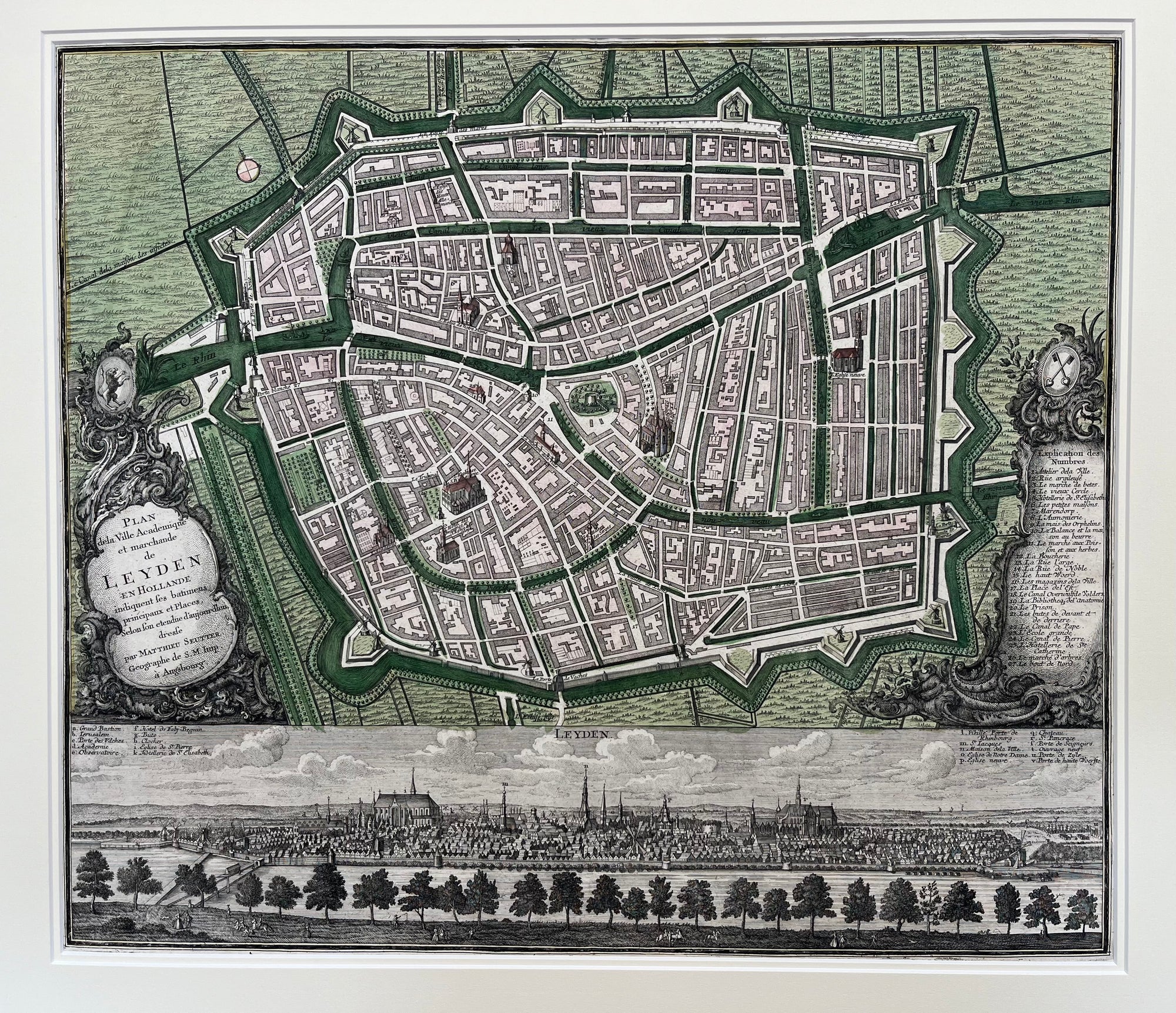
This large Antique Leiden map shows the academic and commercial city of Leiden in Holland. It includes a detailed view of the city and an outline profile below. On the left is a decorated title cartouche. On the right, a cartouche holds the legenda numbered 1-27 and the coat of arms of Leiden.
The top left shows a legenda labeled a-k, with another legenda labeled l-v on the top right. This contemporary hand-coloured engraving was made by Matthaeus Seutter (III) in Augsburg between 1720 and 1730. The city view remains uncoloured, as usual for maps from this period.
Discover all our maps and plans, city views and various prints in our store located in the heart of Haarlem.
About the Artist: Matthaeus Seutter (III)
Matthaeus Seutter (1678–1757) was a prominent German cartographer, engraver, and map publisher from Augsburg. Originally apprenticed as a brewer, he shifted to engraving and cartography under the tutelage of Johann Baptist Homann, a leading German mapmaker of the time. Around 1717, Seutter established his own independent cartographic publishing firm in Augsburg.
He became known for producing a large variety of highly detailed maps, many based on earlier works by Homann and Delisle. His firm gained significant success, and by 1732 Seutter was honored by Emperor Charles VI with the title of “Imperial Geographer.” Seutter continued publishing until his death in 1757. His sons briefly continued the business, which was later taken over by Tobias Conrad Lotter, Seutter’s son-in-law, who became a major 18th-century cartographer.
About the Era: 18th Century (1700s)
During the 18th century, mapmaking became more scientific and precise. Improved instruments like the telescope and chronometer helped cartographers increase accuracy, shifting maps from decorative art to factual documents. Copperplate engraving stayed as the main printing method, producing fine lines, while hand-coloring added visual impact. French cartographers, such as the Cassini family, led national surveys with geodetic measurements and triangulation, while Dutch mapmakers like Joan Blaeu enhanced printing and atlas quality, ushering in a golden age of atlases.
Maps began including more information and notes to help users, and ornate decorations mostly gave way to scientific clarity, except for cartouches and borders. National and colonial ambitions guided map production to aid navigation and territorial claims. By the late 18th century, large-scale surveys set modern cartography standards. Today, 18th-century maps mix scientific knowledge with artistry, are prized by collectors, and have influenced later cartographic methods. They offer insights into Enlightenment exploration and geography.