Full Description
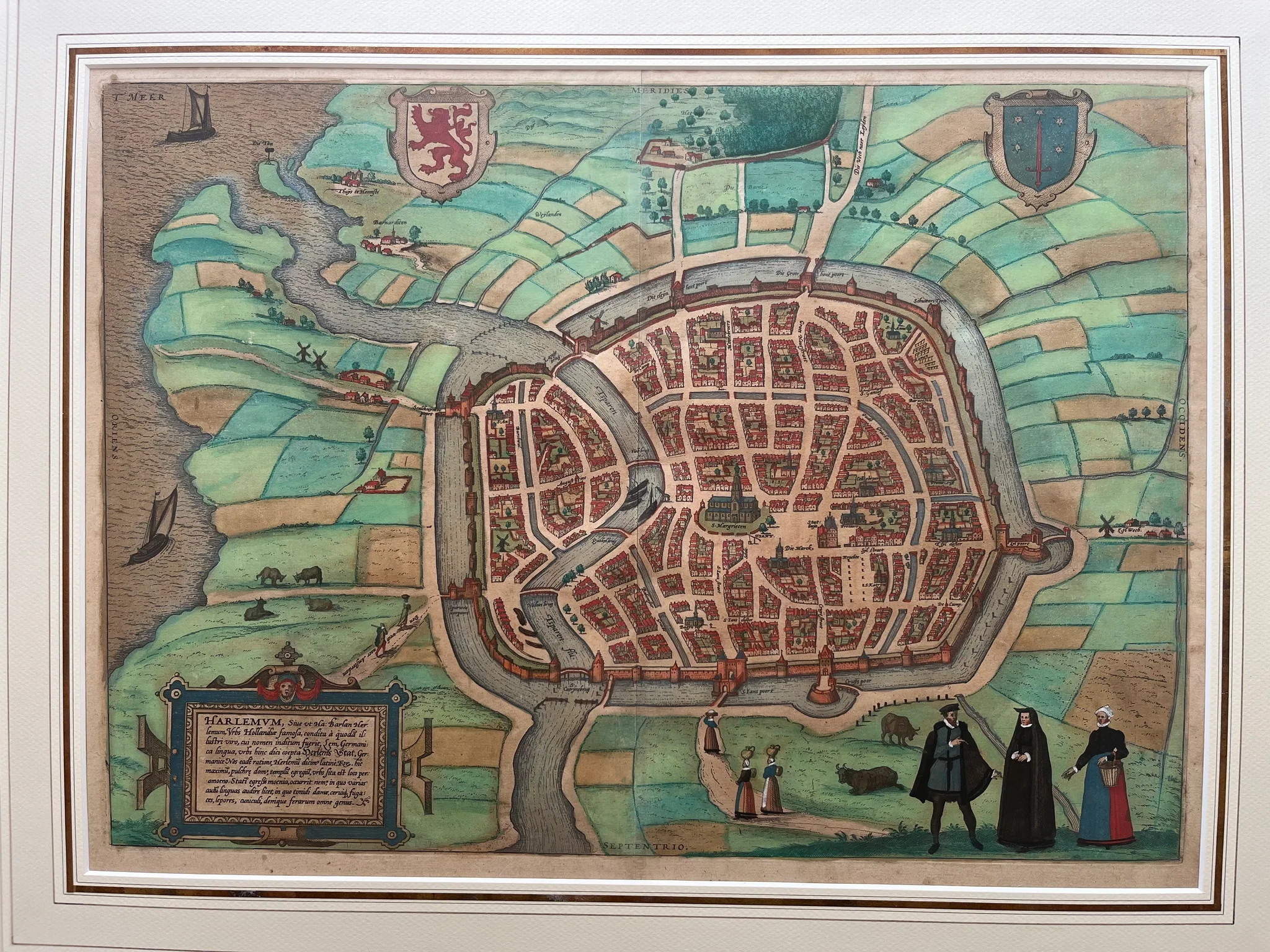
Harlemum, Siue vt Ha: BarlanHerlemum, urbs Hollandiæ is a striking handcoloured map of Haarlem by Braun & Hogenberg. It was published in 1572 as part of the celebrated atlas Civitates Orbis Terrarum, one of the earliest and most detailed collections of city views ever produced. This engraving shows Haarlem’s historic town plan with streets, canals, and key buildings clearly drawn and coloured by hand.
This antique map of Haarlem measures 34 x 47 cm and is in good condition, with Latin text on the reverse. The colouring enhances its charm and historic presence. Collectors appreciate this antique map of Haarlem for its accuracy, decorative quality, and significance within 16th-century cartography. VAT: Margingoods, no VAT.
Make sure to explore all our antique maps collection and our City Views from around the world.
About the Artist: Frans Hogenberg, Georg Braun
Frans Hogenberg (1535–1590) was a Flemish-German painter, engraver, and mapmaker born in Mechelen, Flanders. He is notable for his detailed engravings and maps, especially his contributions to the first modern atlas, “Theatrum Orbis Terrarum,” published in 1570 in collaboration with Abraham Ortelius. Hogenberg’s studio was renowned for creating panoramic city views and historical event engravings, including depictions of battles, massacres, and royal ceremonies related to the turbulent period of the Eighty Years’ War. His prints served as important historical records and propaganda tools. Hogenberg also produced allegorical and metaphorical works, and his engraving of the cartographer Mercator remains iconic. After facing religious persecution as a Protestant, he was banished from the Netherlands and settled in Cologne, where he continued his artistic work. His legacy includes highly valued illustrations that blend art, history, and cartography.
About the Era: 16th Century (1500s)
The 16th century saw a strong growth in mapmaking and printmaking. Copperplate engraving revolutionized cartography, helping mapmakers create more detailed and accurate maps. At the same time, exploration, trade, and religious changes increased Europe’s need for reliable maps. Engravers cut designs into copper plates, inked them, and pressed paper to produce clear images. Afterward, artisans hand-colored many maps to enhance their appeal. This method replaced earlier woodcut printing, allowing finer lines and richer details. Influential figures like Marcantonio Raimondi and Gerardus Mercator contributed to this progress, sometimes collaborating or engraving their own maps.
Core innovators Abraham Ortelius, Gerard Mercator, and Jodocus Hondius blended science and art in their atlases. Their maps represented not only geography but also political power and cultural pride, supporting education and navigation. Today, maps from this period remain highly valued for their beauty and historical importance, inspiring future cartographical work and prized by collectors and museums worldwide.