Full Description
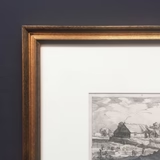
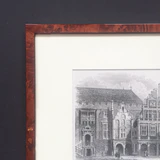
Het Tournooiveld – The Hague is a tinted lithograph with handcolouring made in 1859. It was drawn by Gebr. Bos, lithographed by P. Trap, and published by G. de Geus. The image shows the Tournooiveld area, now part of the Museum Quarter, with elegant buildings and tree-lined streets that reflect the charm of 19th‑century The Hague.
This Tournooiveld The Hague lithograph measures 14.3 x 21.6 cm and is in very good condition. The handcolouring remains soft and fresh, enhancing the calm urban atmosphere. Collectors appreciate this lithograph for its detail, warm tones, and historical value as a record of the city’s graceful architecture. VAT: Margingoods, no VAT.
Explore all our City Views and antique map collection at our store located in the historic heart of Haarlem.
About the Artist: Gerardus Johannes Bos, Pieter Willem Marinus Trap
G.J. Bos (Gerardus Johannes Bos) was a 19th-century Dutch painter born in Leiden in 1825 and known for his detailed landscapes, cityscapes, and animal paintings, especially livestock. He worked as a painter, engraver, and lithographer, producing art that combined scientific observation with artistic skill. Though primarily recognized for his landscape and animal art, Bos contributed to Dutch art history with works appreciated for their romantic and naturalistic qualities.
About the Era: 19th Century (1800s)
The 19th century marked the era of cartography, as mapmaking became professional, organized, and global. Scientists and surveyors used improved instruments and statistical methods, turning maps into trusted scientific documents with greater precision. Surveying advanced with triangulation, precise tools, and national topographic programs. Printing technology improved, adopting lithography and early color printing to produce clearer, richer maps. New thematic maps used techniques like choropleth, flow lines, and dot density to show data visually. Notably, Charles Minard pioneered multivariate mapping, combining multiple data themes on one map.
Map design reflected industrial and Victorian tastes, balancing detail and readability. Governments supported mapping societies to control territories at home and abroad. Maps became essential for urban planning, empire-building, and scientific research. The 19th century also fostered a global map culture, sharing knowledge internationally. Today, 19th-century maps are prized for their science and artistry. They laid the foundation for modern cartography, data visualization, and geographic information science, and are celebrated by collectors and institutions for their insight into industrial-age geography and culture.