Full Description
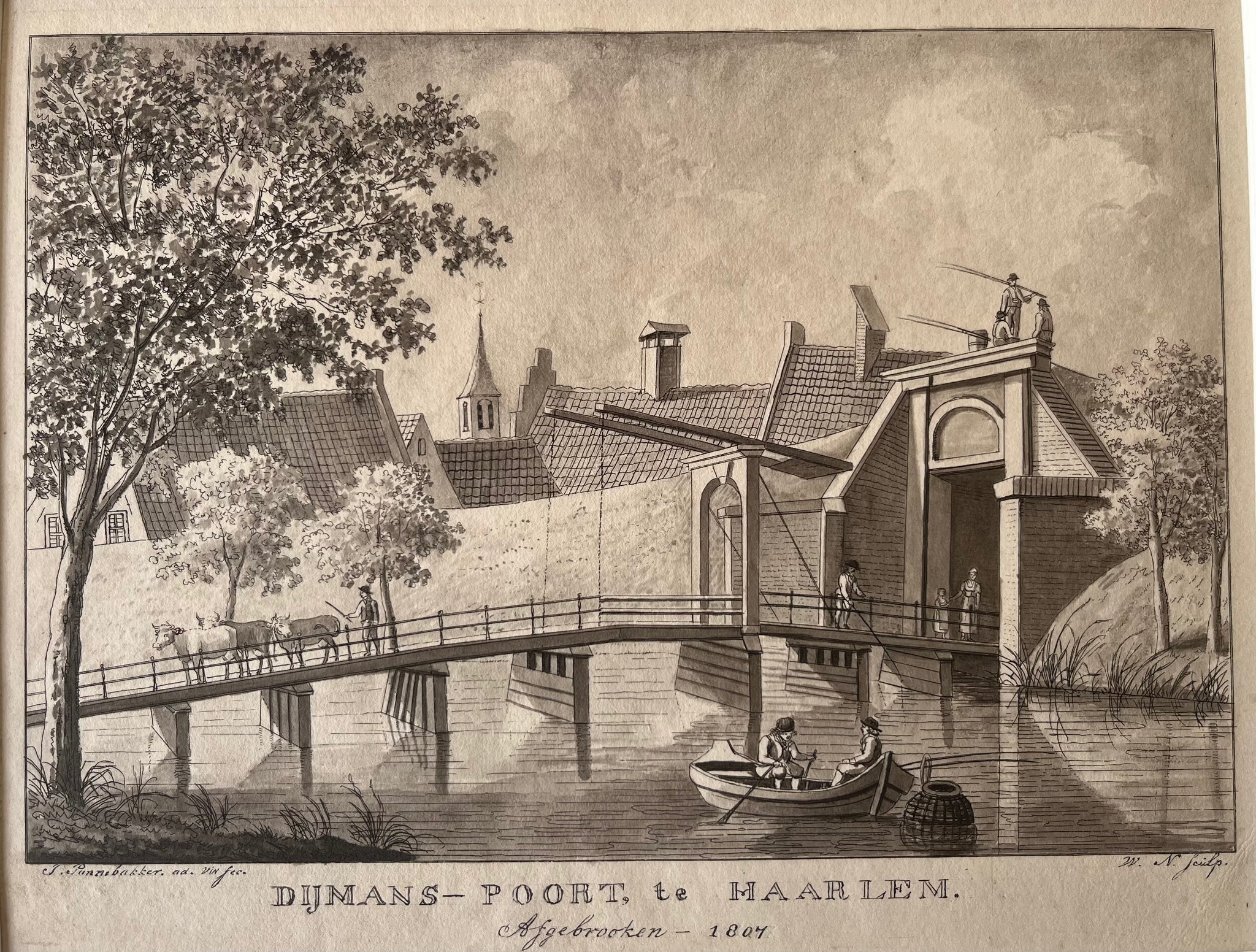
This Haarlem Dijmanspoort Drawing titled ‘Dijmans-Poort te Haarlem, Afgebrooken – 1807’ is a rare early 19th‑century view by Jan Pannebakker. The drawing depicts the northern entrance to Haarlem, once located behind what is now the station at Kennemerplein. In the distance stands the tower of the former leprosy house, known as the Dolhuis.
Pannebakker made this drawing around 1810 as a study for one of his aquatint engravings. The sheet is listed as number 808 in Harlemia Illustrata. The work measures 15.5 x 22.3 cm and is in very good condition. His clean pen lines and soft washes show careful observation and fine artistic control.
This Haarlem Dijmanspoort Drawing is an authentic and rare document of a lost part of the city. It is a valuable piece for collectors of Haarlem history and early 19th‑century Dutch topographical art.
About the Artist: Jan Pannebakker
Unfortunately, there is no information available about this artist yet. We will update this section when possible.
About the Era: 19th Century (1800s)
The 19th century marked the era of cartography, as mapmaking became professional, organized, and global. Scientists and surveyors used improved instruments and statistical methods, turning maps into trusted scientific documents with greater precision. Surveying advanced with triangulation, precise tools, and national topographic programs. Printing technology improved, adopting lithography and early color printing to produce clearer, richer maps. New thematic maps used techniques like choropleth, flow lines, and dot density to show data visually. Notably, Charles Minard pioneered multivariate mapping, combining multiple data themes on one map.
Map design reflected industrial and Victorian tastes, balancing detail and readability. Governments supported mapping societies to control territories at home and abroad. Maps became essential for urban planning, empire-building, and scientific research. The 19th century also fostered a global map culture, sharing knowledge internationally. Today, 19th-century maps are prized for their science and artistry. They laid the foundation for modern cartography, data visualization, and geographic information science, and are celebrated by collectors and institutions for their insight into industrial-age geography and culture.