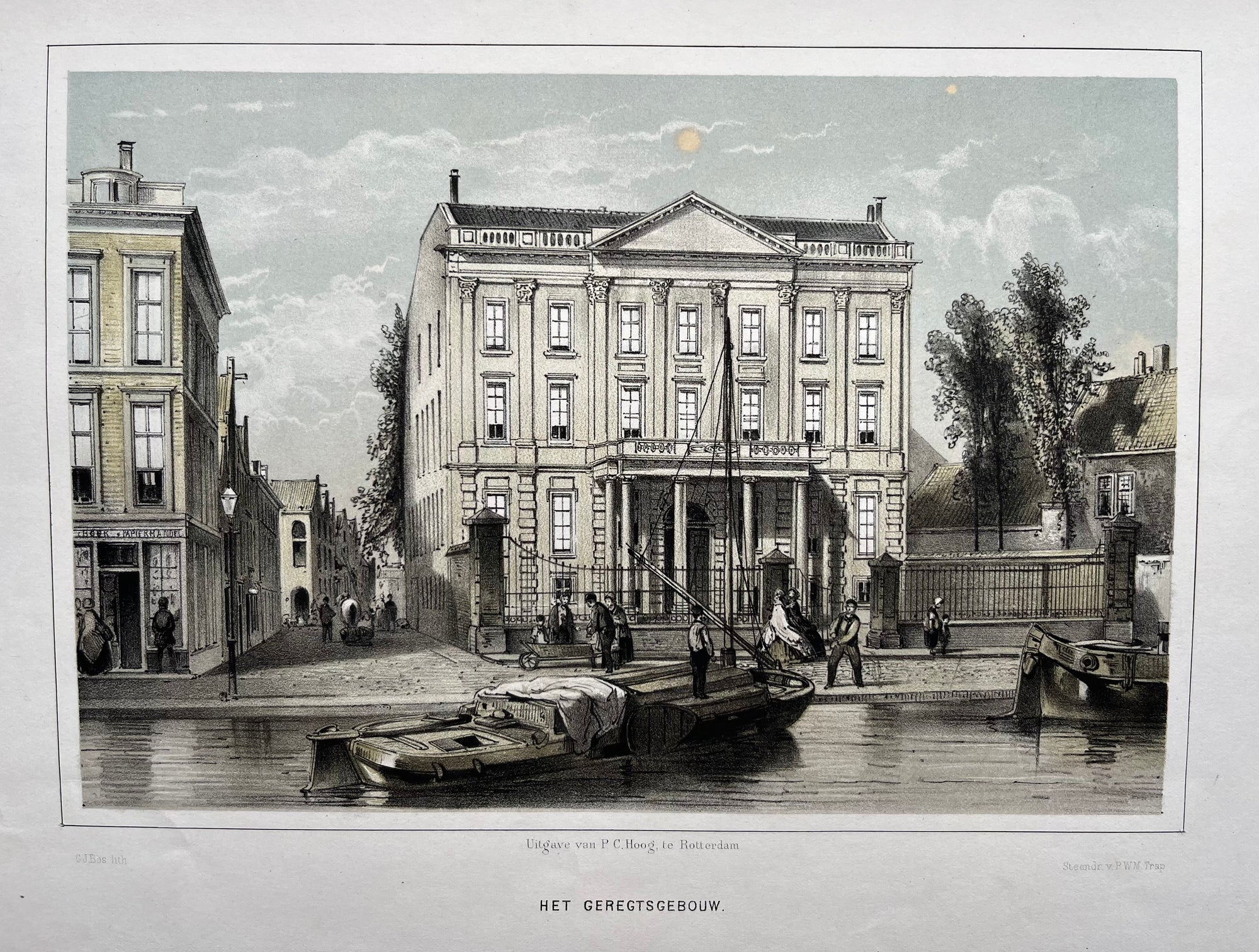
Lithograph by Gerardus Johannes Bos, 1863
€100.00
This authentic antique print, measuring 24 cm × 17 cm , created by Gerardus Johannes Bos as a fine example of Lithograph work from the 19th Century (1800s).
Published by P.C. Hoog, it is preserved in Very Good condition and displays remarkable period craftsmanship.
1 in stock
This vintage lithograph shows Het Geregtsgebouw, the courthouse at Haagseveer in Rotterdam. Created by G.J. Bos and P.W.M. Trap, it was published by P.C. Hoog in 1863. The tinted lithograph measures 17 by 24 cm and is in very good condition, showing some age-toning.
The Geregtsgebouw played an important role in Rotterdam’s judicial history in the 19th century. This artwork captures the architecture and atmosphere of the period. Collectors and lovers of Rotterdam history value this lithograph for its detailed view and historical significance. Owning this vintage Rotterdam lithograph brings a piece of the city’s heritage into your collection. It blends artistic quality with cultural richness, making it a charming display piece.
G.J. Bos (Gerardus Johannes Bos) was a 19th-century Dutch painter born in Leiden in 1825 and known for his detailed landscapes, cityscapes, and animal paintings, especially livestock. He worked as a painter, engraver, and lithographer, producing art that combined scientific observation with artistic skill. Though primarily recognized for his landscape and animal art, Bos contributed to Dutch art history with works appreciated for their romantic and naturalistic qualities.
The 19th century marked the era of cartography, as mapmaking became professional, organized, and global. Scientists and surveyors used improved instruments and statistical methods, turning maps into trusted scientific documents with greater precision. Surveying advanced with triangulation, precise tools, and national topographic programs. Printing technology improved, adopting lithography and early color printing to produce clearer, richer maps. New thematic maps used techniques like choropleth, flow lines, and dot density to show data visually. Notably, Charles Minard pioneered multivariate mapping, combining multiple data themes on one map.
Map design reflected industrial and Victorian tastes, balancing detail and readability. Governments supported mapping societies to control territories at home and abroad. Maps became essential for urban planning, empire-building, and scientific research. The 19th century also fostered a global map culture, sharing knowledge internationally. Today, 19th-century maps are prized for their science and artistry. They laid the foundation for modern cartography, data visualization, and geographic information science, and are celebrated by collectors and institutions for their insight into industrial-age geography and culture.
| Dimensions | 24 × 17 cm |
|---|---|
| Orientation | |
| Artist | |
| Technique | Lithograph |
| Published by | P.C. Hoog |
| Publish Date | 1863 |
| Era | |
| Condition | |
| Frame | No Frame |
Our antique prints are carefully packaged to ensure safe arrival.
Smaller prints are shipped in acid-free, flat protective packaging, while larger works are securely rolled and sent in a sturdy tube to preserve their condition.
Netherlands: €7.50 —
European Union: €15
Outside the EU: On request (contact us for an exact quote)
We offer custom framing for all prints, from classic antique frames to contemporary minimalist styles.
Choose any print from the collection
We discuss frame styles, materials & pricing
The print will be professionally framed and shipped via courier for maximum safety
If you would like your print framed, please contact us, we are happy to advise on styles and options.
Our highest classification. These prints are clean, bright, and exceptionally well-preserved, featuring a strong and crisp image. No notable imperfections.
Prints in this condition show a clean, sharp image. Paper quality or margin size may vary slightly. Minor age-related characteristics, such as small wormholes, light toning, or tiny separations may be present depending on the print date.
No major imperfections. Any minor flaws or historical repairs are fully noted in the product description. Overall a well-preserved and collectible piece.
These prints show noticeable imperfections such as foxing, weaker image strength, or longer separations, but remain collectible. All visible characteristics are clearly described.