Full Description
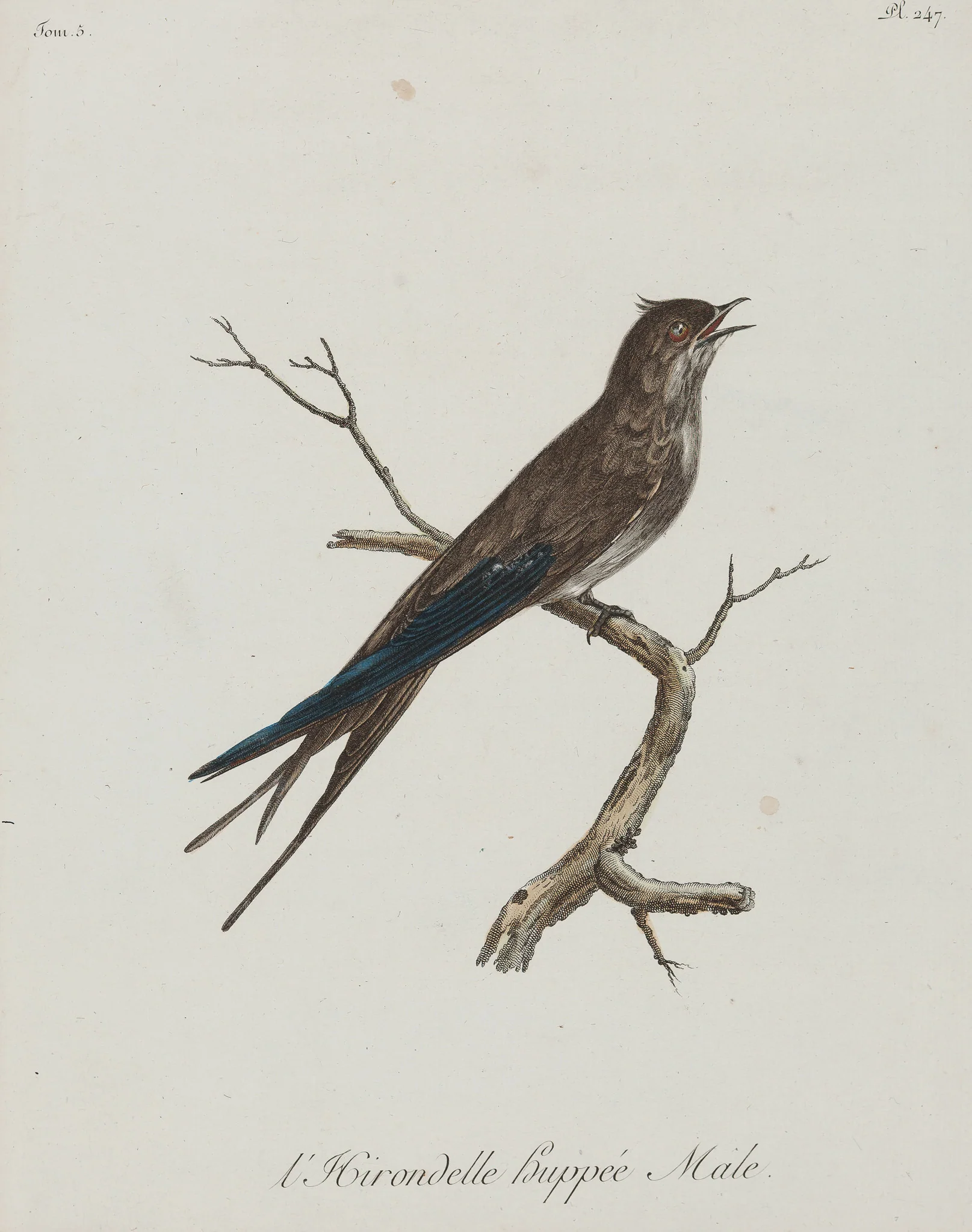
This vintage African bird print showcases the male l’Hirondelle huppée with beautiful period coloring. It comes from plate 247 of Francois Levaillant’s ‘Histoire Naturelle des Oiseaux d’Afrique,’ published between 1796 and 1808. Levaillant was a famous explorer and naturalist who introduced many African bird species to Europe.
The artwork was inspired by the painter Jacques Barraband, known for his precise and detailed bird illustrations. Measuring 29.5 x 22.5 cm, this engraving remains in very good condition with minor spots typical for its age. The vintage African bird print highlights both the art and science of early ornithology. It’s ideal for collectors and lovers of natural history prints. This piece adds a unique historical touch to any collection or display, blending rich heritage with exquisite craftsmanship. With its vivid colors and fine detail, this print captures the beauty of African wildlife impressively.
About the Artist: François Levaillant
François Levaillant (1753–1824) was a French explorer, naturalist, and ornithologist known for his pioneering studies of African birds. Born in Suriname, he traveled to southern Africa in the early 1780s to collect bird specimens. He named species using French rather than scientific Latin names and created detailed color illustrations. Levaillant was one of the first to depict birds in lifelike poses and describe their behaviors. His published works, widely translated, helped expand knowledge of African wildlife. Collectors value his books and specimens for their scientific importance and artistic quality. Levaillant also influenced later naturalists by combining exploration, observation, and detailed documentation in natural history.
About the Era: 18th Century (1700s)
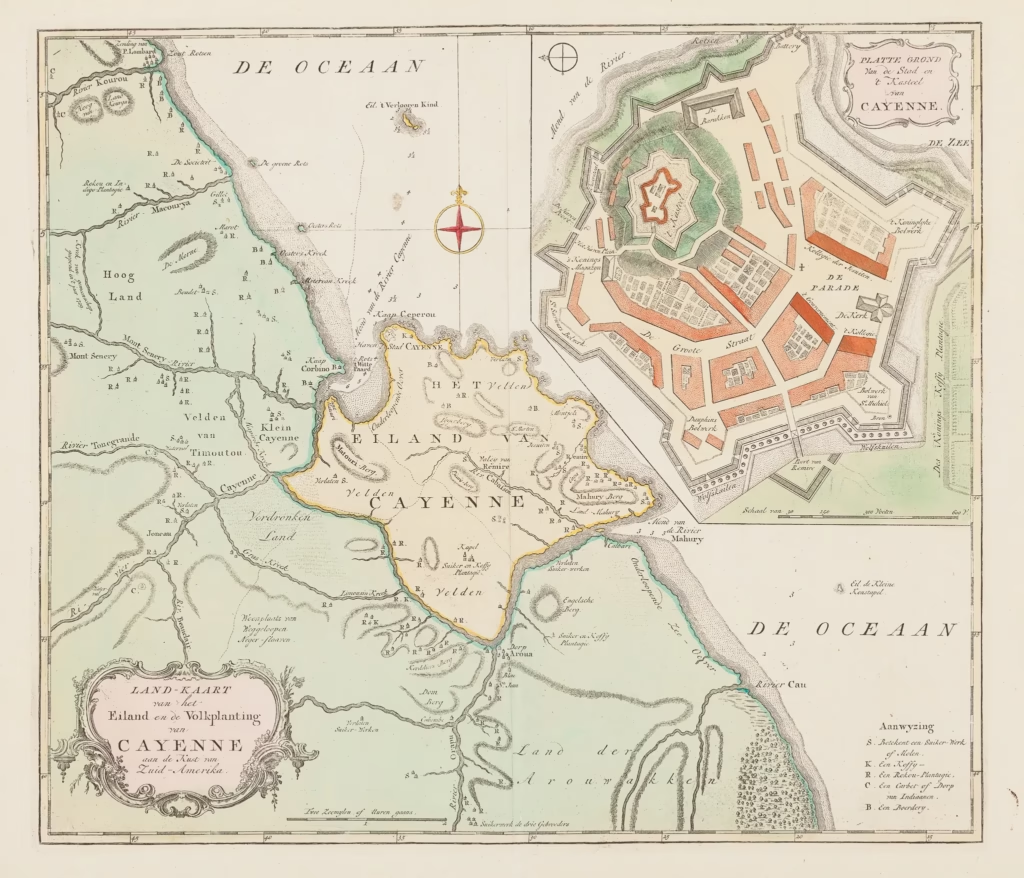
During the 18th century, mapmaking became more scientific and precise. Improved instruments like the telescope and chronometer helped cartographers increase accuracy, shifting maps from decorative art to factual documents. Copperplate engraving stayed as the main printing method, producing fine lines, while hand-coloring added visual impact. French cartographers, such as the Cassini family, led national surveys with geodetic measurements and triangulation, while Dutch mapmakers like Joan Blaeu enhanced printing and atlas quality, ushering in a golden age of atlases.
Maps began including more information and notes to help users, and ornate decorations mostly gave way to scientific clarity, except for cartouches and borders. National and colonial ambitions guided map production to aid navigation and territorial claims. By the late 18th century, large-scale surveys set modern cartography standards. Today, 18th-century maps mix scientific knowledge with artistry, are prized by collectors, and have influenced later cartographic methods. They offer insights into Enlightenment exploration and geography.